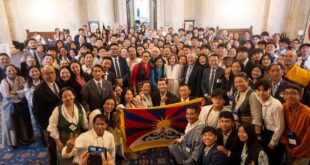
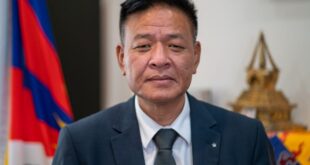
Dharamshala, 14 March 2026: Speaker Khenpo Sonam Tenphel and Deputy Speaker Dolma Tsering Teykhang of the Tibetan Parliament-in-Exile (TPiE) held a meeting with a delegation from the U.S.–China Economic and Security Review Commission (USCC).
The delegation included Michael Kuiken, Vice Chair for the 2026 Report Cycle; Reva Price, Commissioner; Taylor Budowich, Commissioner; Kathleen Hawk, Director of Security and Foreign Affairs; Zoe Merewether, Policy Analyst for Economics and Trade; Kevin Kocher, Political Officer at the U.S. Embassy in New Delhi; and Radharani Thakuria, Project Management Specialist (Foreign Assistance)/Political Specialist at the U.S. Embassy in New Delhi.
During the meeting, the USCC commissioners engaged in an interactive discussion with the Speaker and Deputy Speaker on the functioning, structure, and composition of the Tibetan Parliament-in-Exile. The TPiE leadership responded to a range of questions and provided clarifications on several issues concerning the Tibetan cause in general and the role and responsibilities of the Tibetan Parliament-in-Exile in particular.
In the hour-long discussion, the Speakers reflected on how Tibetans, under the visionary leadership of His Holiness the Dalai Lama, have successfully nurtured and strengthened democratic institutions in exile over the past 67 years. They noted that since arriving in exile, the Tibetan community has steadily built a vibrant democratic system rooted in the principles of freedom, representation, and accountability.
The Speakers also highlighted how the Central Tibetan Administration (CTA), with the continued support of countries such as the United States, India, and many other international partners, has been able to preserve and promote Tibetan culture, language, and religious heritage while simultaneously garnering global awareness and support for the just cause of Tibet.
They expressed sincere gratitude for the consistent support extended by the United States, particularly through key legislative measures such as the Promoting a Resolution to the Tibet–China Dispute Act (Resolve Tibet Act, 2024), the Tibetan Policy and Support Act (TPSA, 2020), and the Reciprocal Access to Tibet Act (2018). The Speakers also welcomed the recent appointment of the U.S. Special Coordinator for Tibetan Issues and acknowledged its significance in advancing international engagement on Tibet.
During the meeting, the Speakers drew attention to several pressing concerns inside Tibet. These included the coercive placement of Tibetan children in colonial-style boarding schools, the ongoing policy of Sinicization of Tibetan Buddhism, the self-immolation protests by Tibetans resisting Chinese rule, and the People’s Republic of China’s interference in the centuries-old religious process of recognizing the reincarnations of Tibetan Buddhist leaders. They also raised serious concerns about potential interference by China in the future recognition of the reincarnation of His Holiness the 14th Dalai Lama.
The discussion further addressed the geopolitical and environmental significance of the Tibetan Plateau, often referred to as the “Third Pole.” The Speakers emphasized its strategic location and its importance as the source of many of Asia’s major rivers that sustain billions of people across South and Southeast Asia. In this context, they underscored that China’s claim over Tibet lacks legitimacy from legal, historical, moral, and political perspectives.
– Report filed by Tibetan Parliamentary Secretariat