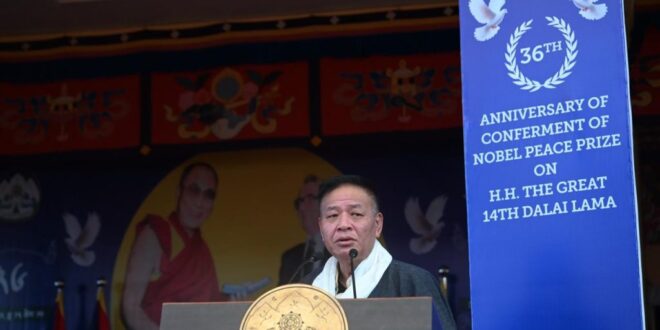
Today marks the thirty-sixth anniversary of the conferment of the Nobel Peace Prize upon His Holiness the Great Fourteenth Dalai Lama of Tibet—the apostle of peace and the supreme leader of the Tibetan people, the International Human Rights Day and the Year of Compassion. The Kashag, on this convergence of the three momentous occasions, offers its deepest obeisance in body, speech, and mind, along with heartfelt greetings to His Holiness the Great Fourteenth Dalai Lama. We also extend our warmest felicitations to the honourable distinguished guests, dear friends and supporters of Tibet across the world. And especially to our Tibetan brothers and sisters, both inside and outside Tibet.
The Norwegian Nobel Committee, in its statement announcing the conferment of this prestigious award, declared that, “since going into exile in India in 1959, His Holiness the Dalai Lama has led a nonviolent opposition to China’s occupation of Tibet”. The Committee further emphasized that “in his struggle for the liberation of Tibet, the Dalai Lama has consistently opposed the use of violence. He has instead advocated peaceful solutions founded upon tolerance and mutual respect in order to preserve the historical and cultural heritage of his people.”
The statement also iterated that His Holiness “developed his philosophy of peace from a great reverence for all living things and upon the concept of universal responsibility embracing all humankind as well as nature.” In the Committee’s view, “the Dalai Lama has come forward with constructive and forward-looking proposals for the resolution of international conflicts, human rights issues, and global environmental problems.”
His Holiness, in his acceptance speech, expressed that the Nobel Peace Prize “reaffirms our conviction that with truth, courage and determination as our weapons, Tibet will be liberated.” His Holiness declared that “suffering of the Tibetan people during the past forty years of occupation was well documented. And the cause of Tibet has been a long and just struggle.”
At a time when our world is shrouded in the darkness of conflict, hatred, and fear, His Holiness the Dalai Lama’s philosophy of peace, rooted in compassion, wisdom, and a profound sense of universal responsibility, has illuminated a viable path toward genuine and lasting peace. It needs no elaboration that the primary purpose of observing this historic occasion is to devote ourselves to the study and implementation of these timeless teachings.
His Holiness the Dalai Lama’s philosophy of peace recognizes that human beings exist within an interdependent society, and that the attainment of world peace is contingent upon individuals assuming ethical responsibility toward others and the natural environment, guided by a sense of universal responsibility. His Holiness articulates a three-tiered framework of peace comprising inner peace, societal peace, and world peace. The inception of world peace begins at the individual level, where the cultivation of compassion, virtue, and universal responsibility lays the foundation for societal peace and nurtures an understanding of the oneness of humanity. His Holiness has envisioned the integration of Social, Emotional, and Ethical (SEE) Learning within educational systems and continues to emphasize the importance of adopting nonviolence and dialogue as the fundamental means of resolving international conflicts and disputes. He further regards environmental protection as an essential prerequisite for lasting world peace. His Holiness’s philosophy thus offers a rational and peaceful alternative for the modern world amid pervasive violence and conflict. A living embodiment of this vision is the Central Tibetan Administration and the Tibetan people, who have steadfastly upheld the principle of nonviolence and pursued the mutually beneficial Middle Way Policy toward the government of the People’s Republic of China (PRC), despite its causing the untimely deaths of over 1.2 million Tibetans and its continued pursuit of policies aimed at the complete eradication of the Tibetan nationality.
This year is being observed globally as the “Year of Compassion” in alignment with the ninetieth birthday of His Holiness the Fourteenth Dalai Lama. The principal purpose of this observance is to advance the compassion treatises which forms the foundation of His Holiness’s philosophy of peace. Compassion serves as an antidote to anger and fear and functions as the mechanism that generates peace. Because compassion arises from understanding the reality of interdependence, it constitutes the ethical foundation for peace. Compassion facilitates dialogue, mutual understanding, and reconciliation, making it the driving force of nonviolence. Transcending religious, linguistic, and racial boundaries, compassion embodies the core of global ethics. This is not merely a modern rendition of Buddhist teachings but rather reflects the wisdom drawn from His Holiness’s lifelong experience and represents the essence of his philosophy of peace. We hope and aspire that this vital resource for international peace research will spread throughout the world and produce meaningful and far-reaching results.
Today also marks International Human Rights Day. We express our solidarity with all those around the world who are denied their basic human rights and extend our hope that those who oppress these rights will gain a sense of right and wrong. Through the understanding of compassion, may they come to respect every human life, listen to every human voice, and honour every human aspiration.
In particular, we hope that the Government of the People’s Republic of China, driven as it is by hatred, greed, and ignorance in its pursuit of eradicating Tibetan national identity and destroying Tibet’s environment, will soon encounter the companionship of compassion, kindness, and wisdom. Consequently, may it cease these destructive policies and turn instead toward a peaceful resolution of the Sino-Tibetan conflict through the mutually beneficial Middle Way Policy.
In conclusion, we earnestly pray for the long life of His Holiness the Great Fourteenth Dalai Lama and the flourishing of his enlightened activities for world peace, human solidarity, and the resolution of the just cause of Tibet. We also pray that His Holiness’s teaching of compassion becomes the spiritual foundation and the essence of practice for all humanity.
The Kashag
10 December 2025
* This is the English translation of the original Tibetan statement. In case of any discrepancies, the original Tibetan text should be regarded as final and authoritative.