Mexico City: Sikyong Penpa Tsering, the democratically elected leader of Central Tibetan Administration, undertook his second official visit to Mexico this October. The visit was of great significance given Mexico’s growing economic ties with China, evident from the advertisements of brands such as Xiaomi and BYD across airports and city streets and the limited public awareness about Tibet’s situation under the repressive policies of the People’s Republic of China. Against this backdrop, Sikyong’s visit served as a crucial platform to raise awareness about Tibet’s political, environmental, and human rights challenges while fostering dialogue on the implications of China’s hegemonic ambitions.
During his engagements in Mexico City, Sikyong held an interactive meeting with Deputy Corina Villegas Guarneros and Deputy Mónica Herrera Villavicencio at the Chamber of Deputies, joined by members of the Indigenous community of Ixhuatlancillo, Veracruz, representatives of civil associations, and long-time Tibet supporters from the Tibet Support Group, Mexico. Deputy Corina graciously hosted Sikyong and Representative Jigme Tsering for breakfast at the Chamber of Deputies. In his address, Sikyong highlighted the resilience of the Tibetan people and the pressing need to raise awareness about China’s expansionist policies. At the conclusion of the meeting, both deputies expressed their solidarity and appreciation for Sikyong’s advocacy efforts.
Sikyong also attended the Reunión en el Congreso del Estado de Jalisco, where he met with four deputies from the Jalisco State Congress. The session was broadcast live by the Congress. Similarly, the Nayarit State Congress welcomed Sikyong for a special address in the General Esteban Baca Calderón Commission Room, attended by Deputies Salvador Castañeda Rangel and José Ramón Cambero Pérez. There were 20 out of 30 State Deputies and a former Federal Deputy present in the meeting. The meeting served as an important platform to raise awareness on Tibet.
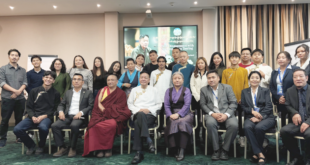
Sikyong also participated in a colloquium organised by former Federal Deputy Julieta Mejía Ibáñez, which brought together civic leaders, activists, and members of civil society. In addition, Sikyong addressed the public at Casa Tibet Mexico and Casa Tibet Guadalajara, met with representatives of the Indigenous Wixarika community, and interacted with long-time supporters of Tibet. In all these interactions, Sikyong spoke extensively about the plight of Tibetans inside Tibet, where Tibetans continue to be denied fundamental human rights and freedoms under pervasive surveillance. Sikyong also highlighted the Chinese government’s colonial-style boarding schools that aim to systematically assimilate Tibetan children into Chinese culture in order to change one whole generation of Tibetans into Chinese, the large-scale exploitation of Tibet’s environment and resources, and the ongoing efforts to eradicate Tibet’s identity.
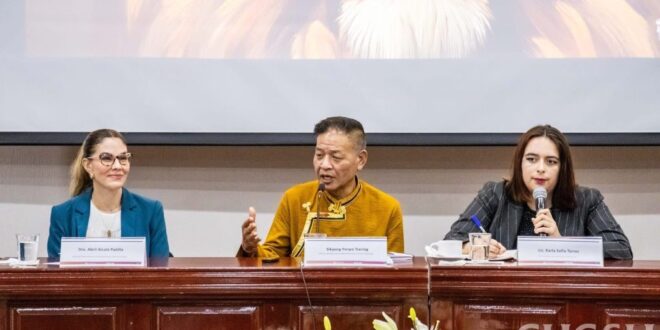
Recognising the importance of educating the younger generation of Mexicans about Tibet and the broader implications of China’s global influence, Sikyong addressed students and faculty at prestigious academic institutions such as El Colegio de México (Colmex) in Mexico City, ITESO University, and CUCSH of the University of Guadalajara. He emphasised the global environmental significance of the Tibetan Plateau, often referred to as the “Third Pole”, as the source of Asia’s major rivers and a vital regulator of the global climate system. Sikyong warned that China’s extensive exploitation of Tibet’s mineral and natural resources not only endangers the plateau’s ecosystem but also poses long-term environmental risks for the entire world. The lectures were met with great enthusiasm and students expressed interest in learning more about the Tibetan cause.
In his discussions, Sikyong also raised concerns over the growing trade imbalance between Mexico and China, noting that beyond the influx of inexpensive Chinese products, there is now an increasing number of Chinese sellers in Mexico’s domestic markets. He cautioned that while such products may appear beneficial in the short term, they threaten local industries and employment in the long run. Furthermore, he drew attention to China’s acquisition of strategic lands and ports worldwide, underscoring the need for Mexico to remain vigilant against Beijing’s hegemonic ambitions.
In an evocative reflection, Sikyong referred to the murals displayed in the Mexican Parliament that depict the nation’s long and proud struggle for sovereignty and democracy. He underscored that democratic nations must stand together against authoritarian regimes and extend mutual support in defending freedom and human dignity.
To reach a wider Latin American audience, Sikyong gave multiple media interviews, including a phone interview with Universidad Autónoma de Coahuila Radio, an in-depth discussion with renowned journalist Enrique Acevedo for Televisa, one of Mexico’s leading news programs, and additional interviews following his meetings with the Nayarit State Congress. Given the broad reach of these outlets across Latin America, these engagements played a vital role in amplifying awareness of Tibet’s struggle and environmental significance. During his official visit, Sikyong was accompanied by Representative Jigme Tsering of the Office of Tibet, Latin America, and Karla Sofia Torres, who assisted with translation. The Jalisco Police provided security escort for Sikyong, with police vehicles leading and following his car as he departed for the airport. With this, Sikyong officially concluded his second visit to Mexico and departed for his next destination.