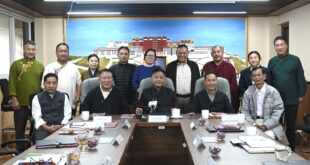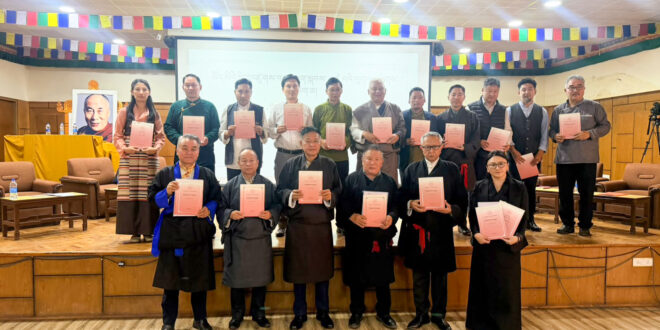
Dharamshala: Three years after the launch of the first Vision Paper: Securing Tibet’s Future by the 16th Kashag of the Central Tibetan Administration (CTA), the 17th Kashag launched a revised version of the paper earlier this morning at Sikyong Hall in Gangchen Kyishong.
Guided by the principles of Equitable Justice, Cooperative Effort, and Moving Forward, the revised paper aims to provide clear direction and guidance to the staff and leadership of the Central Tibetan Administration. It seeks to further strengthen institutional efficiency, enhance productivity, foster cohesive collaboration, promote sustainability, and ensure greater self-reliance in the face of emerging challenges.
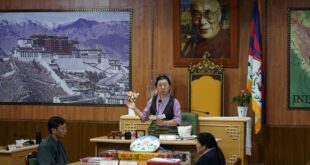
Sikyong Penpa Tsering, using a PowerPoint presentation, introduced the key issues outlined in the paper to a gathering of all CTA staff. The Kalons (Ministers) of the 17th Kashag, with the exception of one, also accompanied Sikyong on the dais during the presentation.
The presentation was conducted with the aim of fostering strong leadership–bureaucratic alignment in fulfilling the CTA’s two key responsibilities: seeking an early resolution to the Sino-Tibet conflict and promoting the welfare of the Tibetan community in exile, while also ensuring efficient and effective administrative functioning of the CTA through strengthening its capacity.
The session was also joined by Representatives of the Offices of Tibet and Tibetan Settlement Officers virtually and was aired online for the general public on Tibet TV.
According to the Sikyong’s message in the paper, “The 16th Kashag published the Vision Paper: Securing Tibet’s Future to help officials, the public, and all concerned understand the importance of Tibet and the Tibetan people; strategies for realising the just cause of Tibet; policies for the welfare of the Tibetan community in exile; and plans to strengthen the Central Tibetan Administration. It sought to bring everyone’s collective efforts together and has yielded positive results. Building on that foundation, we now present a revised paper setting out the 17th Kashag’s overall position, working approaches, and long-term vision for the attention of all relevant stakeholders.”
The highlights in this revised version have been compartmentalised into three sections. The first encompasses the realisation of the just cause of Tibet through strengthening the existing Permanent Strategy Committee; engaging with Chinese people and affected groups; securing recognition of Tibet’s historical status; countering the Chinese government’s interference in the reincarnation of His Holiness the Dalai Lama; countering the Chinese government’s infiltration and deception; and strengthening Tibetan advocacy.
Pertaining to the welfare of the Tibetan community in exile, the second section addresses the reinforcement of social cohesion through safeguarding and sustaining democratic practices, ensuring transparency in administration, strengthening relations between the administration and the public, providing additional care for those in need, empowering women and youth, and strengthening relations with organisations and other bodies. This section also discusses protecting Tibetan identity and sustaining the community by building and sustaining compact Tibetan communities, supporting monastic and religious institutions, promoting healthy settlements, and creating opportunities for sustainable livelihoods.
In the face of Beijing’s systematic efforts to eradicate Tibetan linguistic and cultural heritage, including the coercive enrolment of more than one million Tibetan children in state-run boarding schools and the enactment of the so-called “Law on Promoting Ethnic Unity and Progress”, the paper underscores the promotion of Tibetan education and language through consolidating Tibetan schools in India, sustaining the Basic Education Policy for Tibetans-in-Exile, and promoting the use and development of the Tibetan language and script.
To fulfil these objectives and realise the policies, the final section emphasises strengthening the capacity of the CTA. This section addresses programme planning, implementation, and follow-up in accordance with the laws of the host country, with the aim of ensuring financial transparency and a sound system of accountability. It further highlights the strengthening of institutional capacity through the controlled and appropriate use of artificial intelligence, the establishment of an Institutional Development Index Data Management (IDI-DM) system, and the timely delivery of staff capacity-building training.
Along with the revised Vision Paper: Securing Tibet’s Future, two additional documents outlining the 17th Kashag’s position and providing guidelines for the working approach of CTA departments were also presented to the gathering.
 Loading...

 Reload document
  Open in new tab