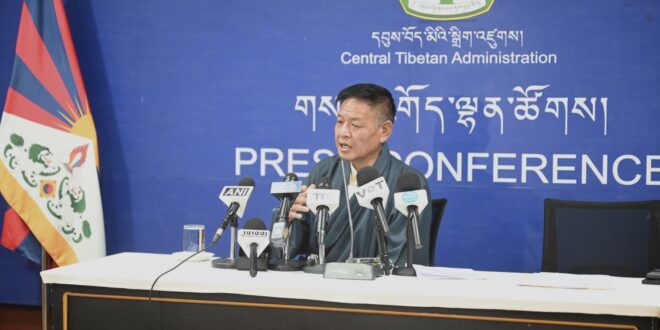
Dharamshala: This morning, Sikyong Penpa Tsering of the Central Tibetan Administration (CTA), at a press meet, officially proclaimed the annual observance of “Tibetan National Identity Preservation Week”, to be observed from the fourth Wednesday of September through the following Wednesday.
The proclamation formally launches a global campaign to confront and counter the various methods and systematic policies implemented by the Chinese Communist Government to eradicate Tibetan identity, particularly its recently enacted so-called “Law on Promoting Ethnic Unity and Progress,” which, under the guise of law, further intensifies the assimilation and eradication of national identities.
A Proclamation on the Observance of Tibetan National Identity Preservation Week
By resolution approved at the 11th session of the 17th Tibetan Parliament-in-Exile designating the fourth week of every September as “Tibetan National Identity Preservation Week”, I hereby proclaim the commencement of this observance effective 23 September 2026. Tibetan National Identity Preservation Week will be observed annually, from the fourth Wednesday of September through the following Wednesday.
The proclamation formally launches a global campaign to confront and counter the Chinese Communist Government’s implementation of various methods and systematic policies aimed at eradicating Tibetan identity—specifically, its recently implemented so-called “Law on Promoting Ethnic Unity and Progress,” which escalate eradication of nationalities under the guise of law. Our campaign must effectively counter the Chinese Communist Government’s observance of the so-called “Ethnic Unity and Progress Propaganda Week,” during which the state organs are directed to execute various forms of state-sponsored assimilation propaganda and re-education campaigns.
The contents and the serious threats posed by the Chinese Communist government’s so-called law have been extensively detailed across key forums and appeals, including:
- The preamble of the resolution adopted during the First Session of the 18th Tibetan Parliament-in-Exile;
- The official statement of the Kashag (Cabinet) on the auspicious occasion of the Birthday celebration of His Holiness the Dalai Lama;
- The official statement on Tibetan Democracy Day;
- The urgent diplomatic appeal dispatched by the Sikyong to foreign governments in June 2026;
- The Kashag’s statement delivered at the 49th-day memorial service for the late martyr Lobga Rangzen; and
- Comprehensive short video awareness campaigns.
On the global stage, governments—including those of the United States, Germany, Belgium, Canada, the United Kingdom, Australia, the Czech Republic, Japan, and the European Union— along with the eight UN Special Rapporteurs and UN High Commissioner for Human Rights Volker Türk, have issued official statements declaring that the Chinese Communist government’s so-called law violates international law, serves as a tool for forced assimilation, and poses a risk of transnational repression.
The United States Congress, the European Union, and the Parliament of the Czech Republic have adopted resolutions confronting this so-called law. In addition, members of Parliament in over twenty free countries have expressed grave concern and strong opposition, while dozens of international human rights organisations and research institutions have released articles and reports exposing the grave dangers of this so-called law in the eradication of nationalities. We take this opportunity to express our heartfelt gratitude to all our international supporters, and we call for sustained, resolute action against the measures of the Chinese government that run against the progress of human society.
On 27 December 2025, the Chinese Communist Government revised the so-called “Law on the National Commonly Used Language and Script,” which mandates Chinese as the primary medium of instruction from pre-school through university, as well as the primary language used in all government offices and public gathering places, while enforcing an annual national propaganda week to promote Mandarin dominance.
I call upon all Tibetan individuals, families, schools, community associations, activists, and Tibet supporters—under the leadership of the respective Representatives of the Offices of Tibet and Tibetan Settlement Officers—to unite in solidarity with the Tibetans inside Tibet with unyielding dedication and fulfil the responsibilities and activities set forth in the public announcement regarding the observance of the “Tibetan National Identity Preservation Week” issued by the Kashag on 21 August 2026.
Today, I am proud to announce the launch of the Principles and Guidelines for the Preservation of the Tibetan Language, recently adopted by the Kashag. To help the public better understand and apply these guidelines, an awareness video will be released shortly. I urge every Tibetan to take ownership of this vital cause and actively fulfil the responsibilities outlined in the guidelines.
I appeal to our youth in particular not to view the observance of the “Tibetan National Identity Preservation Week” as a temporary campaign to be observed for just one week, but as an enduring pledge, and to remember your responsibility as representatives of over seven million Tibetans inside Tibet. I urge you to unite your strength in the struggle for the just cause of Tibet with an unwavering commitment to preserving our Tibetan national identity, and cultivate the courage to become Tibetans who lead on the path of non-violence and compassion, and are capable of taking responsibility for the greater welfare of the world in accordance with the vision of His Holiness the Dalai Lama.
Penpa Tsering
Sikyong
23 September 2026
………………………………………………………………………………………………………………………………………………………………………………………………………………………………
Principles and Guidelines for the Preservation of Tibetan Language
“If Tibetans neglect treasures such as the Tibetan language—which uniquely defines our distinct national identity—and if educated leaders fail to guide the youth, who in turn ignore their elders’ warnings about irreparable loss, our language risks extinction. If Tibetans across China, India, Nepal, and Western countries prioritise Chinese, Hindi, Nepali, and English solely for temporary survival, relying on foreign languages to speak among themselves, it would be both tragic and embarrassing. Therefore, I appeal to every Tibetan to take personal responsibility and make dedicated efforts to cherish and preserve our Tibetan religion, culture, and language.”– An excerpt from His Holiness the Dalai Lama’s message delivered on 11 March 2026.
1. Preface
The Tibetan language is the backbone of Tibetan culture and history and a mirror of the Tibetan people’s unique identity and traditions. It is the primary medium for expressing the Five Major Sciences—arts, medicine, grammar, epistemology, and Buddhist philosophy—and the Five Minor Sciences—poetry, lexicography, prosody, drama, and astrology. It is also a vast treasury for passing down Tibet’s history, politics, economy, military, society, and geography to future generations. It serves as a vital core for safeguarding social unity, collective rights, and the capacity to self-govern.
According to research by modern historians and linguists, the Tibetan script was created in the 7th century, modelled after the Gupta or Brahmi scripts prevalent in Northern India. With a history spanning over 1,300 years, it is recognised as one of the world’s ancient languages with uninterrupted use.
The largest and most complete collections of Buddha’s teachings, Buddhist philosophy, epistemology, and psychology transmitted from India are found in the Tibetan language. Enriched by tens of thousands of volumes of treatises and commentaries, it has become a vital treasury housing crucial components of ancient Indian wisdom.
Studying the Tibetan language helps preserve and promote Tibet’s unique cultural heritage, benefiting all sentient beings. In line with the vision of His Holiness the Dalai Lama, it helps us nurture individuals who can guide others along the path of non-violence and compassion and shoulder responsibility for the greater good of this world.
According to research by UNESCO, UNICEF, and numerous internationally renowned research institutions, implementing mother-tongue education during at least the lower primary school years has been shown to boost students’ self-confidence, foster awareness, and build a solid foundation for learning other languages. It has also proven to significantly enhance cognitive skills, classroom engagement, and overall academic performance. Findings show the method yields clear advantages over forcibly instructing students in a foreign language.
The Chinese Communist government has placed nearly one million Tibetan children in residential schools in Tibet, shifting the medium of instruction to Chinese. It has imposed Chinese-language education in preschools and restricted the use of the Tibetan language in administrative offices. Furthermore, by introducing legal tools under the so-called ‘Law on Promoting Ethnic Unity and Progress,’ it has intensified policies aimed at identity eradication.
Speaking Chinese has become increasingly common in homes in villages and towns in Tibet today, making communication breakdowns between grandparents and grandchildren a widespread concern. This reflects a central aim of the Chinese Communist government’s policy, placing this generation at risk of losing their distinct Tibetan identity.
Within the Tibetan exile community, the rapid emigration to Western countries has outpaced the setup of Tibetan-medium preschools, while birth rates across India, Nepal, and Bhutan continue to decline. Strengthening practical strategies for studying and using the Tibetan language—both inside Tibet and in exile—has therefore become an urgent policy priority focused on education and everyday use.
2. Responsibilities Concerning Learning and Usage of Tibetan Language
a) Responsibilities of Families: Building the Foundation
The cornerstone of the Tibetan language’s sustainability is maintaining uninterrupted transmission of the mother tongue across generations. To do so, parents must embrace their role as a child’s first teacher—teaching their mother tongue from early childhood to ensure the new generation continues to speak Tibetan. To bring this about, each family must;
- Establish a home rule of speaking exclusively in Tibetan during family gatherings, striving to speak pure Tibetan without mixing foreign words whenever Tibetans interact.
- Tell their children Tibetan folktales, history, and culturally relevant stories to foster interest in and affection for the language.
- Create an engaging learning environment by using Tibetan-language children’s stories, films, animations, and nursery rhymes.
- Observe traditional Tibetan festivals to instil religious practices, culture, and customs and traditions in children.
- Participate in community cultural and artistic gatherings to expand opportunities for young generations to use the language in social settings. Such practices are doable and essential duty for every household.
b) Responsibilities of Schools: Ensuring Proficiency in the Tibetan Language
- Maintain the policy of making Tibetan language the primary official language of schools, except where foreign languages are specifically required, so that school practice clearly serves Tibetan language preservation.
- Build a firm foundation to enable children to think and express themselves in their mother tongue during the golden period of cognition; focus on teaching in the mother tongue at the preschool level.
- Tibetan shall serve as the primary medium of instruction through the primary level, with all middle school textbooks in Tibetan, while secondary languages are introduced contextually as appropriate.
- Organise regular debate and public speaking contests, calligraphy competitions, essay contests, art and drama performances, and poetry recitations within and between schools to foster a vibrant Tibetan language environment.
- Create opportunities for philosophy teachers to introduce students to Buddhism, Buddhist logic, and traditional cultural studies.
- Invite scholars in Tibetan language, culture, and arts to inspire students and unlock their latent talents.
c) Responsibilities of the Community: Creating an Ideal Environment for Students to Study and Use the Tibetan Language
- Establish dedicated Tibetan language classes on weekends and during academic holidays, tailored for students attending non-Tibetan schools.
- Provide teachers with modern pedagogical training and expert guidance to deliver high-quality instruction in reading, writing, listening, and speaking for students learning Tibetan as a second language.
- Organise dedicated language immersion programs in areas with significant Tibetan populations, pairing Tibetan children who speak Tibetan as a second language with elders proficient in pure Tibetan for designated periods of language study.
- Provide diverse educational resources for students by creating conditions where activities extend beyond formal classroom instruction, ensuring breaks, entertainment, and recreational play are conducted entirely in Tibetan.
- Display Tibetan as the primary language on signboards, street signs, public announcements, and in community spaces in settlements and Tibetan residential areas.
- Encourage speaking pure Tibetan and learning Tibetan song lyrics during gatherings, such as circle dances (Gorshey), in alignment with White Wednesday (Lhakar) observances.
- Encourage Tibetan social media users to use Tibetan as the primary language in their posts and account handles.
- Encourage social media influencers to prioritise speaking pure Tibetan as well as write in Tibetan.
- Ensure Tibetan language is featured prominently on backdrops and banners for sports events and cultural nights, using Tibetan as the primary language for hosting events.
- Encourage Non-Governmental Organisations (NGOs) to launch effective campaigns supporting Tibetan language study and usage.
d) Responsibilities of the Department of Education, CTA: Ensuring Language Mastery and Nurturing Capable Individuals
- Based on the benchmark of ensuring independent proficiency in the Tibetan language upon completion of basic education, the Department shall structure textbook compilation and curriculum scheduling accordingly, while monitoring, evaluating, and providing encouragement to ensure full, ongoing implementation across all educational systems in support of Tibetan language preservation.
- Develop comprehensive implementation plans to provide higher education scholarships, dedicated academic seats, and competitive teacher remuneration to nurture teachers capable of instructing secondary school subjects in the Tibetan language.
- Through standardised research, introduce a curriculum for teaching dialectics and logic (Riglam) at the upper primary or middle school level. Provide training for teachers to enable the instruction of other academic subjects through dialectical methods.
- Develop interactive multimedia educational tools and digital learning software that reflect curriculum content in contemporary real-world contexts, rather than relying solely on teacher-led instruction.
- Create Tibetan language learning opportunities for students residing in university hostels.
- Provide learning support and facilities for Tibetan students dispersed across various higher education institutions.
- Formally recognise and support higher education institutions that offer Tibetan language courses.
- Provide special scholarship facilities to nurture individuals specialising in traditional Tibetan fields of knowledge whether they are enrolled in formal programs or informal ones.
- Plan and organise annual regional student competitions dedicated to preserving the Tibetan language.
- Formulate and standardise modern social science and natural science terminology aligned with Tibetan grammar and linguistic conventions and ensure its widespread adoption.
- Support research community workforce needs and provide career counselling to students entering higher education accordingly.
- Offer recognition and assistance to individuals and organisations actively promoting effective Tibetan language learning and usage programs.
e) Official policy of the Central Tibetan Administration (CTA)
- Sustain the continued implementation of the Basic Education Policy for Tibetans in Exile.
- Uphold Tibetan as the official language of the Central Tibetan Administration. Strengthen measures to prioritise Tibetan in official correspondence, policy documents, public notifications, and related materials.
- Encourage non-governmental organisations and civil society bodies to actively use Tibetan in their operations.
- Support higher education institutions that teach in Tibetan and incentivise the development of experts in Tibetan culture wherever possible.
- Support the establishment of specialised schools for Tibetan children residing in Western countries.
- Assist programs offering summer camps and online courses focused on Tibetan language, religion, and culture.
- Continue to provide equal basic education facilities and resources for students from the Himalayan region as per the guidance of His Holiness the Dalai Lama.
- Establish expert committees to assist with recognition awards for writers, translators, educators, activists, and parents who make outstanding contributions to the preservation and promotion of the Tibetan language.
- Develop a standardised, comprehensive Tibetan language portal showcasing the Ten Traditional Sciences, culture, and customs of Tibet.
- Lead and encourage measures to expand the use of the Tibetan language across modern media and digital technologies, while supporting intelligent software tools—including Tibetan input methods, machine translation, speech recognition, Artificial Intelligence (AI) and Optical Character Recognition (OCR)—to improve access to Tibetan language use.
f) Policy Implementation and Conclusion
A Tibetan Language Preservation Committee comprising three to five experts with deep knowledge and experience in Tibetan religion, culture, education, and language will be established. The Committee will publish an annual report evaluating the implementation outcomes of this language policy in collaboration with the Education Council of the Department of Education, Central Tibetan Administration
Whether the Chinese Communist government’s policy of restricting Tibetan language study and usage achieves its intended outcomes in a specific period depends on how effectively Tibetans inside and outside Tibet respond to and counter these plans, and how strongly the international community supports our just cause. Therefore, every individual Tibetan must recognise the inherent value of the Tibetan language, take active responsibility for its preservation, and amplify the Tibetan people’s truthful voice across the international arena.
The Kashag
23 September, 2026.