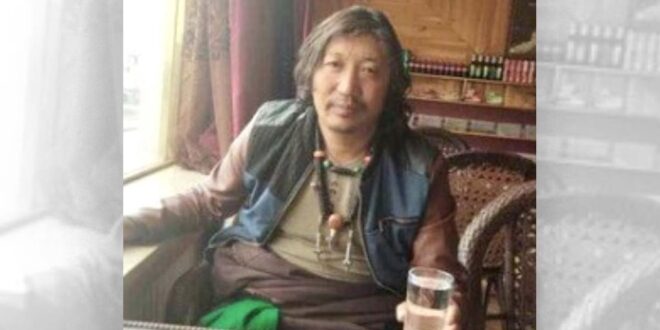
Prominent Tibetan environmental defender and anti-corruption activist A-nya Sengdra has been released from Mianyang Prison in China after enduring more than seven years of unjust imprisonment for his courageous activism. The 55-year-old nomad and community leader returned to his family home in Kyangche Township, Gade County, in Tibet’s traditional province of Amdo—now forcibly incorporated into Qinghai Province—on 7 February 2026.
Severe Health Consequences of Imprisonment
A-nya Sengdra has suffered devastating health complications as a direct result of his brutal imprisonment. Sources confirm that he has developed vision loss, kidney disease, and severe blood pressure problems during detention. Following his arrest in September 2018, he was subjected to systematic torture and denied access to legal counsel for 48 days, during which authorities repeatedly beat him.
Family members, finally permitted a brief visit in August 2025 after years of being systematically denied access, described his profoundly frail and deteriorated condition. Reports confirm he suffered dangerously high blood pressure throughout his imprisonment while Chinese authorities deliberately withheld adequate medical care.
Continued Repression: Post-Release Restrictions and Surveillance
In a blatant attempt to silence A-nya Sengdra and suppress information about his systematic mistreatment, Chinese authorities have imposed severe restrictions and surveillance despite his nominal release. Both he and his family members are prohibited from discussing his case or sharing any photographs or videos on social media platforms. Furthermore, authorities have barred him from travelling to seek urgently needed medical treatment for his serious health conditions, effectively maintaining him under house surveillance in his hometown. This continued persecution demonstrates China’s contempt for basic human dignity and international human rights norms.
Arbitrary Detention Extension
Sengdra’s original seven-year sentence was scheduled to end on 3 September 2025. However, Chinese authorities arbitrarily extended his detention by more than five months, ultimately releasing him on 7 February 2026. Sources indicate the extension was allegedly based on fabricated accusations of “prison rule violations” or theft, yet no official announcement or transparent judicial procedure was ever provided. The International Federation for Human Rights (FIDH) rightfully characterised this extension as arbitrary detention in flagrant violation of international fair trial standards.
A Voice for Environmental Protection and Anti-Corruption
A-nya Sengdra earned widespread respect as a community leader in Tibet’s Golog region through his unwavering efforts to protect Tibet’s fragile ecosystem and expose endemic government corruption. In 2014, he co-founded a voluntary organisation called “Mangdon Ling” (Public Affairs Forum) with fellow nomads to campaign against illegal mining activities, poaching of endangered species, and the systematic embezzlement of public funds by corrupt local officials.
His activism specifically targeted the mismanagement of poverty alleviation and housing subsidies intended for relocated nomads. In one notable instance, he questioned the disappearance of 18 million yuan designated for housing facilities that were never constructed. His work proved remarkably effective—local Tibetans credited his campaigns with forcing authorities to initiate payment of promised subsidies and minimum livelihood allowances that had been systematically withheld.
Prior to his 2018 arrest, over 200 local Tibetans supported Sengdra’s campaign to file a petition with the Provincial Discipline and Inspection Bureau against the embezzlement of poverty alleviation funds by local authorities. In August 2019, the Bureau dismissed several local government officials—including the Party Secretary of Tsangkor Sholma Township, the head of the Township government, and the director of the Gade County Poverty Alleviation Bureau—for deliberately ignoring the embezzlement of funds designated for standardised housing construction. This official action vindicated Sengdra’s years of courageous anti-corruption work.
Fabricated Charges and Denial of Fundamental Legal Rights
A-nya Sengdra was initially arrested by Chinese authorities in 2014 on spurious allegations and sentenced to one year and three months in prison, from which he was released on 18 October 2016.
Less than two years later, on 4 September 2018, Chinese security forces re-arrested him in Gade County on transparently fabricated charges of “gathering people to disturb social order” and “picking quarrels and provoking troubles”—deliberately vague accusations routinely weaponised under Article 293 of PRC criminal law to silence activists who dare criticise the state.
Throughout his detention, Sengdra was systematically denied access to legal counsel and subjected to severe torture. His detention was extended multiple times, and his lawyer’s request for bail in January 2019 was summarily rejected. Shockingly, local Chinese authorities attempted to pressure Sengdra’s lawyer, Lin Qilei, to fabricate fraud charges to strengthen the indictment. Lin Qilei courageously refused this illegal and unethical demand.
On 6 December 2019, after being held in pretrial detention for more than 14 months, the Gade County Court sentenced Sengdra to seven years in prison following what international observers universally characterised as a sham trial. His lawyer argued that the charges were entirely baseless and represented part of a broader political crackdown on so-called “underworld forces”—a cynical campaign the government exploited to suppress legitimate political and cultural expression throughout Tibet.
Nine other Tibetan nomads were sentenced alongside Sengdra: Soedung, Chinthrum, A-shol, Do Sang, Wangyal, Gyaltsen, Ngogbey, Orgyen Tsering, and Wangchen. These individuals were unlawfully imprisoned solely for their campaign work and for courageously voicing opposition to corruption committed by local government officials.
China’s Systematic Violations of International Human Rights Obligations
The case of A-nya Sengdra represents yet another stark example of how the People’s Republic of China systematically and deliberately violates its binding international human rights obligations in Tibet. The Chinese government bears direct legal responsibility for multiple grave violations:
- Deprivation of fundamental rights and freedoms by criminalising peaceful activism and legitimate environmental protection work
- Torture and cruel, inhuman treatment through systematic beatings and deliberate denial of essential medical care
- Denial of legal rights by refusing access to legal counsel and conducting sham trials that violate fair trial standards
- Enforced disappearance by keeping families uninformed about arrests and preventing family contact for extended periods
- Arbitrary detention by extending prison sentences without any transparent judicial procedures
- Post-release persecution through ongoing surveillance, travel restrictions, and censorship imposed on released activists
“This case stands as yet another stark reminder that China continues to egregiously violate the fundamental human rights of Tibetans, who persist in their resistance and endure tremendous suffering despite the PRC’s propaganda claims that Tibetans lead a ‘harmonious’ life in Tibet. The Chinese government relentlessly manipulates its own legal system to criminalise Tibetan activists and systematically crush grassroots anti-corruption campaigns,” stated Tenzin Kunkhen of the Human Rights Desk, Department of Information and International Relations, Central Tibetan Administration.
Sustained International Advocacy and Solidarity
Sengdra’s case generated significant international attention throughout his unjust imprisonment, demonstrating the global community’s commitment to defending human rights in Tibet:
- In August 2023, three United Nations Special Rapporteurs urged the Chinese government to provide comprehensive details on his health and detention conditions, emphasising that the systematic lack of information constituted a deliberate attempt to conceal his situation from international scrutiny
- In May 2020, four UN human rights experts and the UN Working Group on Arbitrary Detention called on the Chinese government to immediately drop all charges against Sengdra, expressing grave concern that his legitimate human rights work was being criminalized
- The US State Department’s 2023 Country Report on Human Rights documented Sengdra’s case, noting he was held incommunicado for 48 days without legal representation, followed by 14 months of pretrial detention
- The Congressional-Executive Commission on China highlighted his case in their 2020 Annual Report as one of two Tibetan political prisoners of particular international concern
- The International Federation for Human Rights (FIDH) adopted an urgency resolution at their 42nd Congress in Bogota in October 2025 demanding Sengdra’s immediate and unconditional release
- The EU Delegation’s Human Rights Day statement in December 2025 demanded his immediate and unconditional release, explicitly noting the arbitrary sentence extension and his severely deteriorating health
- Over 140 Tibet advocacy groups mobilised in solidarity following the arbitrary extension of his sentence in 2025, with prominent international and Tibetan organisations consistently demanding his release and documenting his case as emblematic of China’s systematic persecution of environmental defenders and anti-corruption activists in Tibet
Call to Action
It is imperative that the Chinese government must immediately lift all restrictions imposed on A-nya Sengdra, allow him unfettered access to necessary medical treatment, cease all surveillance and harassment of him and his family, and end its systematic persecution of Tibetan environmental defenders, anti-corruption activists, and all those who courageously advocate for justice, transparency, and accountability.
The resilience and courage demonstrated by A-nya Sengdra and countless other Tibetan activists inspire the world. Their struggle for human rights, environmental protection, and good governance deserves strongest support and sustained advocacy.
– Filed by UN, EU, and the Human Rights Desk, Tibet Advocacy Section, DIIR