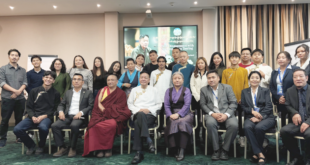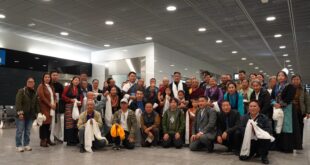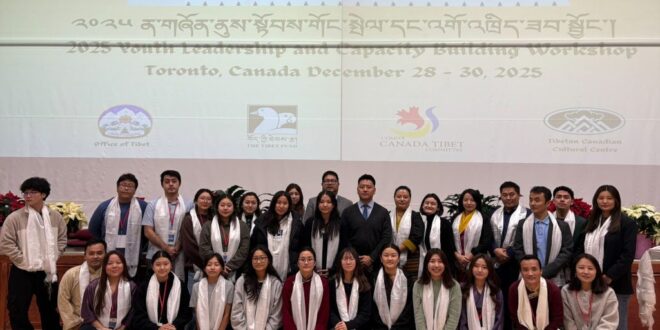
Toronto: The 2025 Youth Leadership and Capacity Building Workshop -Canada was successfully conducted from December 28 to December 30 at the Tibetan Canadian Cultural Centre. The Office of Tibet, in collaboration with Tibetan Canadian Cultural Centre, Canada Tibet Committee and Tibet Fund organised the three-day workshop, bringing together approximately 40 young Tibetan students and young professionals from Toronto, Ottawa and Calgary. The workshop featured distinguished speakers including Dr. Namgyal Choedup, Representative of His Holiness the Dalai Lama and the Central Tibetan Administration to North America; Dr. Tenzin Sonam from Emory University; Bhuchung Tsering from the International Campaign for Tibet; and various Tibetan-Canadian professionals and community leaders. Through a designed curriculum combining lecture and presentation sessions, interactive group discussions, meditation practices, and practical advocacy training, participants gained essential skills and knowledge to become effective voices for Tibet.
The workshop commenced early on Sunday morning with participant registration and arrival at the Tibetan Canadian Cultural Center. Following a communal breakfast that allowed participants to network and build initial connections, the formal proceedings began with welcome address and introduction, setting the tone for the three-day intensive program. The introduction also highlighted His Holiness the Dalai Lama’s vision for the future of Tibet and the role that the younger generation must play in realising that vision. Dr. Tenzin Sonam from Emory University led the first meditation session, establishing a practice that would bookend each day of the workshop. Dr. Tenzin Sonam presenting on secular ethics and emotional management. Drawing from His Holiness the Dalai Lama’s extensive work on secular ethics—a framework for ethical behavior based on universal human values rather than religious doctrine—Dr. Sonam explored how leaders can navigate complex emotional landscapes while maintaining their integrity and effectiveness.
Representative Dr. Namgyal Choedup delivered a presentation on His Holiness the Dalai Lama’s vision for Tibet’s future and the structure and functions of the Central Tibetan Administration (CTA). This session provided essential context for understanding the broader framework within which Tibetan advocacy operates. He explained how these commitments inform the CTA’s policies and programs, and how young leaders can align their work with this vision. Representative also provided a candid assessment of the current situation in Tibet, discussing the ongoing challenges of Chinese occupation, cultural suppression, and human rights violations. He emphasised that while the circumstances are difficult, His Holiness’s approach of dialogue, non-violence, and the Middle Way remains the principled path forward.
Bhuchung Tsering from the International Campaign for Tibet (ICT) led a powerful session on Tibetan-Canadian identity and advocacy. As someone who has worked on Tibet advocacy for decades, Tsering brought strategic insight to the discussion. The session explored the complex dynamics of maintaining Tibetan identity while integrating into Canadian society. Tsering discussed the opportunities and challenges faced by Tibetans in Canada—a country with strong democratic institutions, respect for human rights, and a multicultural framework that generally supports cultural preservation. Navigating dual identity as Tibetan and Canadian, Tsering’s presentation was particularly resonant for the young participants, many of whom were born in Canada or arrived at a young age. His message was clear: maintaining Tibetan identity and advocating for Tibet’s freedom are not incompatible with full participation in Canadian life—rather, these commitments can be mutually reinforcing when approached with wisdom and skill.
The afternoons featured set of group sessions, allowing participants to engage more intimately with the day’s major themes. The cohort was divided into three groups, rotating through focused discussions on: Secular Ethics and Tibetan Values, explored how traditional Tibetan Buddhist values can be articulated and applied through the lens of secular ethics, making them accessible and relevant in diverse, pluralistic contexts.
His Holiness’s Vision and the Central Tibetan Administration, participants delved deeper into the CTA’s structure, challenges, and opportunities, with space for candid questions about governance, democratic participation, and the role of youth in institutional development. China-Tibet Conflict and Resistance in Tibet, provided historical context for the occupation, examined the various forms of resistance employed by Tibetans inside Tibet, and discussed how the diaspora can effectively support and amplify these voices. The group discussion format encouraged more personal engagement, allowing participants to voice concerns, ask difficult questions, and begin building the networks that would sustain their advocacy work beyond the workshop.
A Sino-Tibetan Dialogue in observance of the Year of Compassion on the first evening brought together the Tibetan workshop participants with approximately 40 Chinese democracy activists and Chinese youth from across Canada. This dialogue represented a practical application of His Holiness the Dalai Lama’s consistent emphasis on person-to-person connection, mutual understanding, and the distinction between the Chinese people and the Chinese Communist government. The session was structured to create space for open exchange while maintaining an atmosphere of respect and compassion. Chinese participants included veteran democracy activists who had been engaged in human rights work for decades, as well as young people who had recently become involved in democratic movements, particularly following the 2022 White Paper protests in China. The dialogue featured opening remarks from both Tibetan and Chinese representatives, followed by moderated discussions on shared experiences of oppression, the value of non-violent resistance, and the possibilities for cooperation in building a democratic future.
Sherab Tharchin, Director of the Canada Tibet Committee, provided an in-depth presentation on Tibet advocacy specifically focused on Canada’s capital. As the primary organization coordinating Tibet advocacy at the federal level, the Canada Tibet Committee plays a crucial role in keeping Tibet on the agenda of Canadian parliamentarians and government officials. Tharchin’s presentation covered the Canadian federal government and how Tibet advocacy fits into Canadian foreign policy. Tharchin emphasised that while much Tibet advocacy focuses on high-level diplomatic and parliamentary engagement, the foundation of this work is grassroots organising. Members of Parliament respond to their constituents, making it essential for Tibetan-Canadians and supporters across the country to maintain regular contact with their elected representatives.The session also addressed recent successes and ongoing challenges in Canadian Tibet advocacy, including efforts to pass legislation addressing forced labor concerns, sanctions on Chinese officials responsible for human rights violations in Tibet, and support for the Tibetan community in Canada.
The final day began with the now-familiar rhythm of breakfast and meditation, grounding participants as they prepared to integrate the workshop’s lessons and look toward their future roles as leaders. One of the workshop’s most inspiring sessions brought together two Tibetan-Canadians who work as parliamentary staffers in the Canadian federal government. Kalsang Tsomo and Mingyur Paldon demonstrated that young Tibetans can serve the cause of Tibet while pursuing professional careers in mainstream Canadian institutions. Both shared their journey into public service, the nature of their work, and how they maintain their Tibetan identity and advocacy commitments within professional contexts.
Tenzin Yangkee, National Coordinator for Canada of the Volunteer Tibet Advocacy Group (V-TAG), presented on youth-led organising and the specific work of V-TAG in mobilising young Tibetans for advocacy and community engagement in Canada. V-TAG represents a model of peer-led, grassroots organizing that empowers young people to take ownership of the Tibet movement. Yangkee discussed the structure and mission of V-TAG and shared successful campaigns and initiatives led by V-TAG chapters . Yangkee shared inspiring examples of youth-led initiatives, She emphasised that young people bring energy, and fresh perspectives that are essential for keeping the Tibet movement dynamic and relevant.
Deki Shukla, President of the Tibetan Canadian Cultural Centre, provided a compelling case study in community building and institutional development. The Cultural Centre itself—the venue hosting the workshop—stood as tangible evidence of what organised, committed community members can achieve. The Centre represents a model of diaspora institution-building and she emphasised that such institutions are crucial for maintaining community cohesion, transmitting culture to younger generations, and providing a base for advocacy work. She also spoke candidly about challenges, generational differences in vision and priorities, and navigating the politics of community organisations.
The workshop concluded after participants shared their reflection on three-day workshop and submitting evaluation. Many expressed hope that the workshop cohort would remain connected as a network of emerging leaders supporting one another’s growth and work.
– Report filed by Office of Tibet, Washington DC