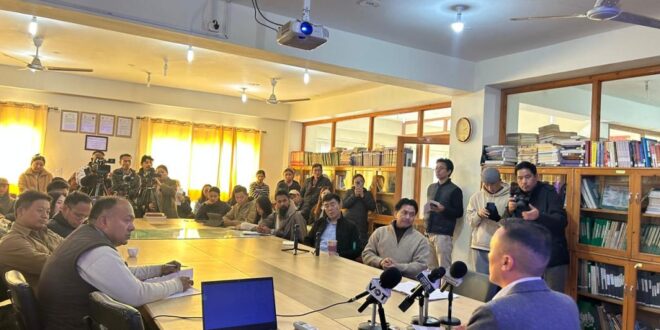
Dharamshala: This afternoon at around 2:00 pm, the Tibet Policy Institute (TPI), under the Department of Information and International Relations of the Central Tibetan Administration, held a press conference to highlight recent developments in Zachukha, eastern Tibet. The press release, held at TPI hall was addressed by Deputy Director Tempa Gyaltsen Zamlha. The event was attended by members of various Tibetan media outlets as well as media personnel from national and local Indian media.
Press Release
Tibetans Report Mass Arrests and Communications Blackout Following Protest Against Gold Mining in Kashi, Kham Zachukha
Kashi village, Kham Zachukha, Tibet — November 5, 2025
Tensions have escalated sharply in Kashi village, Sershul County (Dzachukha), after local Tibetans reportedly discovered a gold-mining operation at a site known as Serkhok (Gold Valley) in the afternoon (2:11pm) November 5. According to accounts from residents, the villagers confronted the miners and alerted township authorities, triggering a chain of events that has since led to widespread arrests, a communications blackout, and an intensified security presence throughout the area.
Villagers say that instead of addressing concerns over the mining activity, township officials dismissed their objections, telling them, “You have no right to interfere. The complete ownership of this land belongs to the government. We will investigate and make decisions.” Officials allegedly claimed the villagers’ attempt to halt the mining was illegal.
Years of reported repression, combined with the authorities’ refusal to address environmental or community concerns, led to rising frustration among locals. What began as a dispute quickly escalated into a confrontation between villagers and government representatives.
Night-Time Arrests and Disappearances Reported
On the evening of 6 November, at approximately 6:50 p.m., authorities began what residents describe as systematic, door-to-door arrests in Kashi village. Individuals were allegedly detained and transported to Sershul County for interrogation.
Local sources estimate that around 80 Tibetans have been detained , though the exact number remains unknown. Several people reportedly remain missing, with families unable to obtain information about their whereabouts.
Township Sealed Off and Communication Devices Confiscated
Residents report that the united front office, public security bureau, armed police, and township officials jointly sealed off the entire Kashi township shortly after the arrests began. Authorities allegedly held a meeting warning local people not to speak about the incident, saying it must “never be leaked to higher levels or to the outside world,” and that any such disclosure would be treated as a serious criminal offense.
Security forces reportedly entered homes, confiscated mobile phones, and conducted invasive searches. Armed police and military personnel are said to now patrol all roads and public areas, detaining individuals even for suspected disapproval of the mining operation.
Long History of Mining and Environmental Damage
The gold-mining incident is not isolated, according to residents. Mining activities in the region have reportedly occurred repeatedly since the 1990s. Locals allege that officials from Sershul County and township authorities, along with private businessmen, have vested interests in mining and have facilitated decades of environmentally destructive projects.
Under the guise of “development,” authorities have also built dams and opened additional mining sites that residents say have caused severe ecological harm to local rivers, grasslands, and sacred landscapes.
Cultural and Religious Restrictions Intensify
Community members report that Kashi township authorities have for years imposed heavy restrictions on Tibetan religious and cultural practices. Currently, these restrictions reportedly include: Allowing only four monks to gather for prayer at local monasteries, Prohibiting public mani (prayer) gatherings, Preventing elders from conducting circumambulation during major festivals, Banning gatherings of more than ten people, Prohibiting students from attending cultural workshops or study programs during school holidays. Residents say these measures form part of a daily pattern of control over Tibetan cultural life.
A Community Under Siege
The situation in Kashi township is described by locals as “extremely tense.” With communications cut, arrests ongoing, and movement heavily restricted, villagers express fear for the safety of family members and uncertainty about what may follow.
The above accounts reflect long-standing patterns of excessive mining, surveillances, and cultural and religious restrictions documented across Tibetan regions in recent decades.
Updated Situation – December
- Detainees were subjected to inhuman and degrading treatment, including being denied access to urination and defecation facilities both day and night, and being deprived of sleep.
- Throughout their detention, individuals were provided with only a minimal quantity of cold tsampa water (roasted barley flour mixed with cold water) once per day, constituting deliberate starvation and inadequate nutrition.
- During violent and coercive interrogations, several detainees suffered broken ribs, kidney-related illnesses, and severe physical and psychological deterioration, including relapse of tuberculosis, indicating the use of torture and cruel, inhuman, or degrading treatment or punishment.
- Medical examinations were conducted at Shershul Dzong (county) hospital; however, medical reports were not fully disclosed, raising concerns about lack of transparency and denial of access to medical information.
- Detainees were forcibly compelled to sign written pledges committing them to remain silent and refrain from sharing information with the outside world, constituting coerced confessions and restrictions on freedom of expression.
- Numerous elderly individuals were arbitrarily detained. Their mobile phone records were extensively examined, and they were warned and threatened against disseminating information before being released. Following their release, many elders were repeatedly summoned for “re-education” sessions, during which manual inspections of their mobile phones were conducted to closely monitor communications, indicating ongoing surveillance and harassment.
- Some detainees who became seriously ill in custody were released, while others were freed only after being forced to sign pledges not to oppose the mining activities and not to disclose information, and were forced to sign fabricated witness statements falsely asserting that local Tibetans had assaulted Chinese officials without justification, raising concerns of forced false testimony.
- The whereabouts of 7 Tibetans arrested among 80 individuals in November remain unknown, constituting cases of enforced disappearance under international human rights law.
- Only authorised individuals are permitted to speak with journalists, while local Tibetans are explicitly prohibited from doing so, amounting to severe restrictions on freedom of expression and access to information.
- Surveillance cameras, recording devices, and monitoring equipment have been installed in numerous private homes to record conversations and monitor daily activities, resulting in systematic violations of the rights to privacy, freedom of expression, and freedom of movement.