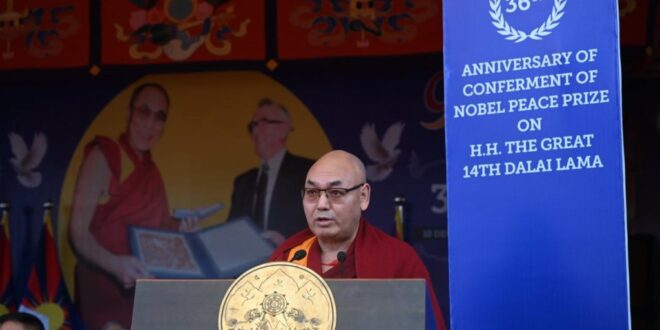
We are gathered here today to commemorate a momentous occasion, marking the 36th anniversary of the conferment of the Nobel Peace Prize, the world’s most prestigious award for peace, on the Omniscient King of Victorious Ones, His Holiness the Great 14th Dalai Lama, the crown jewel of the samsara and nirvana, including the realm of the heavenly beings; the King of Dharma of The Three Realms; a champion of world peace; the sovereign of the entire corpus of Buddhist teachings on earth; the destined patron deity of the Snowland of Tibet; the embodiment of the noble Lord of the World Avalokiteshvara in the form of a monk in saffron robes; and the universal treasure of the Tibetan people. On this auspicious occasion, we on behalf of all Tibetans in Tibet and exile extend our heartfelt greetings and best wishes to His Holiness with joy, faith, and pleasure, expressing heartfelt gratitude and remembrance for his kindness.
His Holiness the Dalai Lama assumed responsibility for the temporal and spiritual affairs of Tibet at a very young age. And as a result of the armed occupation of the Tibetan nation by the Chinese government, approximately 80,000 Tibetan people including His Holiness the Dalai Lama were forced to flee their homeland in 1959, to enter India and seek refuge in it. The government of India provided hospitality and assistance, and His Holiness, keeping in view his long-term vision, newly established a Tibetan government in exile, settlements for housing the Tibetan refugees, as well as monasteries, Schools, the Tibetan Medical and Astrological Institute, and various cultural centres dedicated to preserve the religious, linguistic and cultural heritage of the Tibetan people. His Holiness also directed his efforts at gradually transforming the Central Tibetan Administration in exile into a full-fledged democratic system. It is all thanks to his efforts that today the situation in Tibet and of the Tibetan people have become matters of great interest across the world.
It is on the basis of his practice of the view of dependent origination and the abiding by the principle of non-violence that His Holiness has emerged as an unsurpassed guide to the path of non-violent means to people across the world. Apart from that, His Holiness has based his campaign for the cause of Tibet solely on non-violent methods and made efforts to reach a resolution of the issue of Tibet through a negotiated settlement. In recognition of his guidance and efforts towards the settlement of all conflicts across this world by non-violent means, the Norwegian Nobel Committee awarded His Holiness the Nobel Peace Prize on 10 December 1989 in Oslo. This prize has been awarded since 1901 to individuals or organisations for outstanding contributions in the fields of peace, democracy, human rights; for fostering of fraternity between nations; and so forth. The awarding of the Nobel Peace Prize to His Holiness the Dalai Lama not only enhanced the prestige of the award but also greatly contributed to significantly boosting awareness and understanding of the just cause of Tibet internationally.
In his Nobel Peace Prize acceptance speech, His Holiness the Dalai Lama said: “As a Buddhist monk, my concern extends to all members of the human family and, indeed, to all sentient beings who suffer. I believe all suffering is caused by ignorance. People inflict pain on others in the selfish pursuit of their happiness or satisfaction. Yet true happiness comes from a sense of inner peace and contentment, which in turn must be achieved through the cultivation of altruism, of love and compassion and elimination of ignorance, selfishness and greed.”
His Holiness also said: “The problems we face today, violent conflicts, destruction of nature, poverty, hunger, and so on, are human-created problems which can be resolved through human effort, understanding and the development of a sense of brotherhood and sisterhood. We need to cultivate a universal responsibility for one another and the planet we share.” And so forth.
And so, irrespective of what the status of a person may be in this world, if everyone can practice being less selfish and being contented, being loving and compassionate, and being cherishing of others, this world will naturally become one happy family. And so, whatever difficulties and troubles we may face, it is extremely important to make efforts to solve the problems of war and harm by spreading understanding of human consciousness and by taking into consideration and by taking responsibility under the notion of fraternity among each other. And so, the Tibetan Parliament-in-Exile takes the opportunity provided by this occasion to appeal to the global community, especially political leaders of the various countries, to act accordingly.
As per announcement, the Nobel Peace Prize for the year 2025 has been awarded to Ms. Maria Corina Machado “for her tireless work promoting democratic rights for the people of Venezuela and for her struggle to achieve a just and peaceful transition from dictatorship to democracy.” As she accepts the Nobel Peace Prize today, the Tibetan Parliament-in-Exile extends its congratulations and best wishes to her.
We also take note of the fact that today is also international Human Rights Day. On the 10th of December in 1948, the United Nations General Assembly adopted Resolution 423(V) at its 317th session, officially announcing the Universal Declaration of Human Rights. And the international Human Rights Day has been observed since 1950, marking 75 years today. Since the coming into force of this Declaration, all human beings have been recognised as born free and equal in dignity and rights. Everyone has been recognised as entitled to all the rights and freedoms set forth in this Declaration, without distinction of any kind, such as race, colour, sex, language, religion, political or other opinion, national or social origin, property, birth or other status. The Declaration recognises the fact that the freedom and rights of movement in all its recognised aspects, speech and expression, assembly and association and so forth are basic to all persons, and no one has any right to infringe them. In keeping with these provisions of the Universal Declaration of Human Rights, the opportunity to exercise the rights and freedoms enshrined therein have been available in most countries of the world in terms recognised in it.
Nevertheless, when it comes to the situation in Tibet, forget all about political, religious, linguistic and so forth freedoms and rights, enjoying even basic freedoms. including the freedom of movement in all its aspects, remains problematic, marked, in fact, by continued total denials. What is more, the government of China prevents any truthful investigation of the real situation there, while, on the other hand, it spreads distorted information about it, devoid of any truth. Hence, we emphatically appeal to the United Nations Organization to ensure a proper implementation of the provisions of this international law in Tibet by means of exerting pressure as well as providing encouragement to the government of China.
The Central Tibetan Administration is observing this year as the “Year of Compassion” in connection with celebrations marking the 90th Birthday of His Holiness the Dalai Lama. In a series of events drawn up for this purpose, the Tibetan Parliament-in-Exile carried out a number of activities, among which was a photo exhibition which showcased His Holiness the Dalai Lama’s journey of granting democracy to the Tibetan people out of a feeling of great love and compassion. This event was held over three days at the Thekchen Choling Tsuglakhang in coincide with the Tibetan Democracy Day. After that, the exhibition was held successively in Shimla to coincide with the birth anniversary of Mahatma Gandhi at the Sambhota Tibetan School; at the Himachal Pradesh University, Shimla; at the Jawaharlal Nehru University, Delhi; at St. Stephens College, Delhi
University; and at the Tibetan Youth Hostel, Delhi. Likewise, the photo exhibition was also held at Punjab University, Chandigarh, and Lovely Professional University, Jalandhar. At each of these venues, the development and progress of Tibetan democracy in exile and a brief overview of His Holiness the Dalai Lama’s noble, spiritually informed activities have been presented through photographic images.
Recently, on 3rd December during the winter session of the Himachal Pradesh state Legislative Assembly at Tapovan, near Dharamshala, the members of the Standing Committee of the Tibetan Parliament-in-Exile met with key leaders from the two political parties. These included Shri. Kuldeep Singh Pathania, Speaker of the Himachal Pradesh Legislative Assembly; Shri. Sukhvinder Singh Sukhu, Chief Minister of Himachal Pradesh; and Shri. Jai Ram Thakur, the Leader of the Opposition in the state assembly. The Tibetan Parliamentary delegation attended an ongoing meeting of the assembly as observers. The delegation extended heartfelt gratitude to the state government and its people in view of the fact that Dharamsala has long served as residence of His Holiness the Dalai Lama and the seat of the Central Tibetan Administration. A special kind of relationship was established between the Legislative Assembly of the state and the Tibetan Parliament-in-Exile.
In this 21st century – His Holiness the Dalai Lama has greatly inspired millions of people with his teachings on compassion, love, peace, human consciousness, and ethical values. In recognition of his contributions in these fields, His Holiness has received hundreds of awards and honours till date from governments, parliaments, and various governmental and non-governmental organisations around the world. His Holiness’s secret body, speech and mind noble deeds have been immensely beneficial to all beings across the world and, in particular, to the Tibetan people. And the debts of gratitude thereby owed to him is truly immense. From across the world, numerous influential figures, apart from thousands of other people, visit Dharamshala in an endless stream to see Holiness the Dalai Lama at his home. The Tibetan community, including organisations, private entities and related bodies, have been making numerous offerings to His Holiness the Dalai Lama, beseeching that he live a long life and continue his work. That His Holiness has graciously responded affirmatively to these prayers is a source of benefit to all beings in general and, especially, to the Tibetan people. He has resolved to live to be well beyond hundred years of age. This will be of great benefit to all beings in general and especially to Tibet both religiously and nationally. And so, we take the opportunity provided by this occasion to pray with deepest of devotion that His Holiness remain in the mode of the embodiment of infinite life of the Victorious One and not abandon the destitute Tibetan people, so that his noble deeds may continue uninterrupted. On this occasion, we also wish to express heartfelt gratitude to the government and people of India, who are our hosts, as well the United States, Europe and all other individuals, public and private organisations, that have continuously supported us.
In conclusion, we pray that His Holiness the Dalai Lama, the irreplaceable leader of the Tibetan people, may live for a hundred aeons as a bulwark of support and protection for all beings in the three realms, and especially to the people of Tibet; that, on this basis, all his wishes may be seen fulfilled without obstacles and in spontaneous manners, and that the just cause of Tibet may be seen resolved in all speediness.
The Tibetan Parliament-in-Exile
10 December 2025
* In case of any discrepancy between this English translation and its Tibetan original, the latter should be considered as authoritative and final for all purposes.