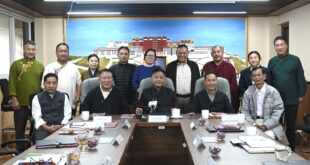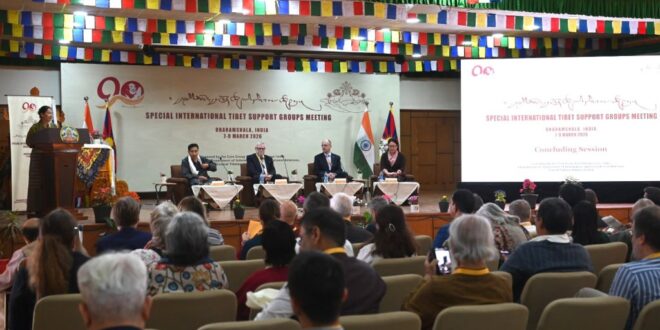
Dharamshala: Following three days of intensive deliberations and discussions on a wide range of topics—including briefings on the current situation inside Tibet, strategies to counter China’s increasingly distorted narratives, and reflections on why Tibet matters more than ever in the evolving geopolitical landscape—the Special International Tibet Support Groups Meeting concluded on the eve of the 67th anniversary of Tibetan National Uprising Day.
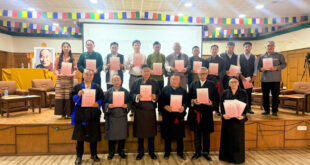
On the first day of the meeting, following the inaugural ceremony, participants issued a strong declaration affirming their united and unwavering commitment to stand in solidarity with the Tibetan people in their struggle for freedom, justice, and the preservation of Tibet’s distinct national identity.
On the morning of 9 March, participants were granted an audience with His Holiness the Dalai Lama. Following the audience, the visiting Tibet supporters reconvened at the venue for the closing ceremony.
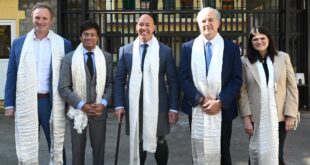
Honourable MP Michael Brand, Parliamentary State Secretary at the Federal Ministry for Family Affairs, Germany, and Honourable Senator Jiří Oberfalzer, Vice President of the Czech Senate—who were in Dharamshala as distinguished guests for the commemoration of Tibetan National Uprising Day—featured at the closing ceremony alongside Kalon (Minister) Norzin Dolma and Secretary Karma Choeying of the Department of Information and International Relations (DIIR), Central Tibetan Administration (CTA).
The concluding ceremony was coordinated by Master of Ceremony Tenzin Palmo, Tibet Support Groups Liaison Officer at the DIIR.
Honourable MP Michael Brand delivered the valedictory address, in which he remarked, “Coming here is like coming home for me. There are so many wonderful and inspiring people here working day in and day out for their nation and their people, along with many friends from all over the world joining that effort. One can only bow to all of you for your tireless commitment to such a noble cause.”
Reflecting on the current global context, he noted, “This world is undergoing a huge shift. We do not yet know where or when this shift will end. Addressing such a distinguished audience at a time of fundamental global change requires us to reflect on these transformations. Even then, we can say that these important years are but a blink of an eye compared to the thousands of years of Tibetan history and culture—and even less when measured against the eternity that many of us believers know exists.”
He continued by observing that the pace of global change has created uncertainty and anxiety in many parts of the world. “We can see, read, and even feel how fast our world is changing. Because of these shifts, many people and regions on our small planet feel insecure and even fearful. But we here, most of us, are in a somewhat better position—people grounded in our convictions and guided by our faith. We are aware that we are not alone on this planet; there are good forces watching over us in these uncertain times.”
Highlighting the global moral influence of His Holiness the Dalai Lama, he stated, “One authority of truly global reach—touching the hearts, minds, and even the souls of countless people on this planet—is at the centre of our thoughts today. Of course, I am speaking of His Holiness the Great Dalai Lama. When we talk about the fundamental shifts of our era, many people focus on the increasing dangers in the coming months, years, and decades.”
While briefly speaking about the ongoing domestic and international challenges currently facing the People’s Republic of China, the Honourable MP said, “That was proof to the whole world—not only in China and the region—that the regime is insecure, unsafe, rattled, and challenged.”
To further support his point, he also referred to China’s mishandling of its recent domestic political issues. As China views Tibet’s distinct cultural, religious, and linguistic identity as a threat to its Han-centric notion of unity, he stressed, “We have to raise awareness around the globe that the precious Tibetan culture—unique and of immense importance to the whole world—is under increasing threat.”
He condemned China’s attempts to eradicate this uniqueness and distinction from the surface of the Tibetan Plateau and called for greater efforts from Tibet supporters to safeguard it. “We have to spread the news—the ugly and tragic news—of the hundreds of thousands of children being forced into Chinese indoctrination, separated from their parents and families, only to cut the roots of the precious Tibetan language and tear apart the Tibetan heritage.”
In conclusion, the Honourable MP appealed, “Let us stand up for civilisation, for culture, for humankind, and for humanity and kindness—just as His Holiness has done throughout his extraordinary life. Let us stand up against forces of destruction, brutality, and inhumanity.”
Following him, Honourable Senator Jiří Oberfalzer spoke to the gathering.
“Being member of the Czech nation, a small nation in the central Europe who went through different period of history where we struggled not having freedom and being oppressed by outsider, the Soviet regime. We understand very well what means to live under such super powers and not being free to live our own original life.”
The Honourable Senator recalled that, after his country became free in 1989, President Václav Havel invited His Holiness the 14th Dalai Lama who has made a great impression. “He brought a message of non-violence and peaceful relation to the world and among the people.”
“It is difficult to describe any factual or realistic way of how to get out of the Chinese suppression, the power incomparable, to a people of small nation. But this is not the case of Tibet, because I would say specially thanks to His Holiness who very well know what. is the positions and situations of Tibetan people.”
While commending European’s commitment to support those who are in subjugation, the Honourable Senator lamented that “We are still prisoners of business. It is Europe who created strength of Chinese economy.”
To demonstrate how Tibet-related initiatives are taking place in Czech Republic such as institution of NGOs that work for Tibet cause as well as Uyghurs in China. He also mentioned current Czech President, Honourable Petr Pavel’s meetings with His Holiness the Dalai Lama and Sikyong Penpa Tsering last year in India, making it the first case of a sitting President’s official meeting with Tibetan leadership in bold move. He also mentioned his meetings with both the former and current Sikyong of the CTA at his Senate office.
“Even Tibetan leadership are willing to negotiate, China is not open to this solution and they simply wants to delete Tibet from the world. And, I think we should, not only say, but show that we don’t accept anything like this,” the Honourable Senate concluded.
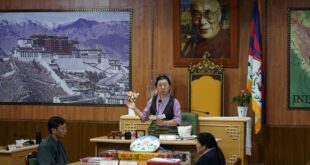
As the head of the organising department, Kalon Norzin Dolma delivered the concluding remarks and stated, “As we mark the conclusion of this three-day Special International Tibet Support Groups Meeting, we do so at a moment of significant consequences.” The Kalon said, “We recognise that this gathering marks not an end, but the birth of a renewed collective journey toward the resolution of the Sino-Tibet conflict and the fulfilment of the aspirations of the Tibetan people.”
Expressing her honour at being on the same dais with two distinguished guests, the Kalon said, “The histories of both nations, from the fall of the Berlin Wall to the triumph of the Velvet Revolution, stand as monumental testaments to the world. Your presence here reminds us that even the most formidable walls of oppression eventually crumble under the relentless power of non-violence and the unwavering weight of truth.”
Further expressing her gratitude to all the participants from 32 nations, the Kalon stated, “Your presence is a profound reminder that we do not stand alone.”
“Standing here before you all, I cannot overstate the critical urgency of the situation inside Tibet. It is too evident from the briefings throughout the sessions what not just the Tibetan people but the world stands to lose. As I speak, around a million Tibetan children sit in state-sponsored colonial boarding schools in Tibet. While the world has acknowledged such colonial residential schools of the past as a tragedy and a stain on the history of humanity, a million Tibetan children being forced into this very same nightmare today are being deprived of the opportunity to learn their own language or to immerse themselves in their culture.”
Given the CCP’s misperception of Tibet’s distinct identity as a threat to its stability and the falsehood of its claims that Tibet has been part of China since antiquity, the Kalon expounded, “To hide its own facade, the PRC seeks to forcibly sinicise and eradicate this ancient civilisation. As a result, the Tibetan language, our religion, and our culture—the very heartbeat of Tibetan identity—are under a coordinated existential threat and attacks from all sides.”
The Kalon highlighted how the message of Tibetans’ long-pursued belief in the “science of mind” is crucial for this tumultuous world with rising conflicts, and how the bearers of this profound treasure are still suppressed to such an extent that these traditions are now under increasing threat of extinction if not safeguarded. Further underscoring the geopolitical importance of the Tibetan Plateau, the Kalon shared her concerns over the rising challenges faced by neighbouring regions and downstream dwellers of the Tibetan rivers.
“The resolution of the Sino-Tibet conflict is not merely in the interest of the Tibetan people; it is in the wider interest of China and the world at large. Let the peaceful resolution of this Sino-Tibet conflict reignite the world’s faith in non-violence.”
“As the global landscape shifts, we must manoeuvre with strategic agility, adapting our methods without ever losing our core values. To meet this immense responsibility, we must ensure that the work of our support groups is institutionalised. We must move beyond discussion toward strategic alignment—one that is coordinated and action-oriented. We must ensure that support for Tibet becomes a permanent fixture in the halls of parliaments, in the strategic agendas of nations, and in the conscience of civil society,” the Kalon stressed.
With a vote of thank from Secretary Karma Choeying, the three-day Special International Tibet Support Groups Meeting was successfully wrapped up.