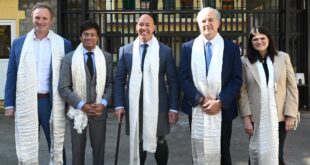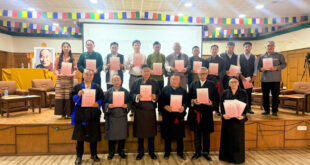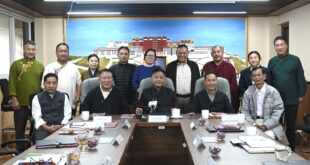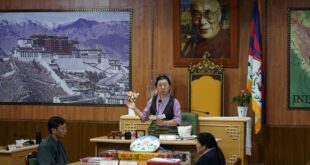
Washington D.C.: On the evening of 28 January 2026, Sikyong Penpa Tsering arrived at Dulles International Airport, where he was received by Representative Namgyal Choedup and Chinese Liaison Officer Tsultrim Gyatso of the Office of Tibet, Washington, D.C., amid wintry conditions following recent snowfall in the capital region. The visit forms part of Sikyong’s official programme in the United States, which includes meetings on Capitol Hill, as well as participation in major conferences and summits.
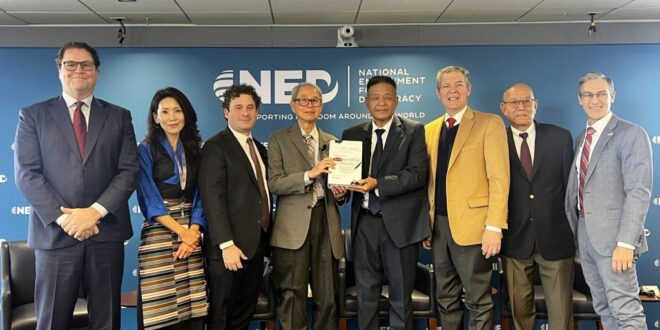
A key engagement of the visit took place on the morning of 29 January 2026, when Sikyong attended the official launch of Professor Hon-Shiang Lau’s latest book, Tibet Was Never Part of China Since Antiquity. The publication draws exclusively on authoritative Chinese historical records and documents, presenting a scholarly examination of Tibet’s historical status through China’s own sources
The launch event featured Professor Hon-Shiang Lau alongside Ambassador Sam Brownback, former United States Ambassador-at-Large for International Religious Freedom, and Bhuchung K. Tsering of the International Campaign for Tibet (ICT). The panel discussion was moderated by Josh Rogin, columnist for The Washington Post. The event was organised by the National Endowment for Democracy (NED), and the book has been published by Optimum Publishing International.
In his remarks, Professor Lau elaborated on the rigorous methodology underpinning his research, explaining that all cited materials were selected on the basis of three strict criteria. First, the records must have been authored by recognised Chinese government organisations prior to 1949. Second, the same records must have been reprinted or republished by Chinese government after 1949. Third, the materials must remain verifiable through public libraries or publicly accessible databases operated by the People’s Republic of China. Professor Lau noted that records meeting these conditions cannot be credibly disputed by the Chinese government, as they originate from its own historical corpus.
Professor Lau further emphasised that, since the 1950s, the Chinese government has repeatedly relied on distortions and fabricated claims concerning Tibetan history. In view of the need for a credible evidentiary approach, he underscored the importance of relying on irrefutable sources to counter such narratives. “The likelihood of anyone getting tough on China on behalf of Tibet is small,” said Professor Lau, making it all the more essential for Tibetans and supporters to engage and inform the Chinese public directly about Tibet’s historical realities.
Addressing the gathering, Sikyong Penpa Tsering commended Professor Lau’s work for countering false Chinese narratives on Tibet through the use of imperial Chinese records themselves. Sikyong noted that, in his engagements with governments around the world, he frequently references Professor Lau’s research alongside Tibet Brief 2020 by Michael van Walt, which is grounded in legal analysis, to demonstrate that Tibet was never a part of China.
Bhuchung Tsering of the International Campaign for Tibet stressed that the book conveys a clear message to the Chinese authorities that the Tibetan issue will not fade away. Ambassador Sam Brownback, in his remarks, unequivocally stated that Tibet is not part of China.
Following the book launch, Sikyong Penpa Tsering held a virtual interaction with members of the International Campaign for Tibet across various regions. The day’s programme concluded with Sikyong attending a symposium hosted by ICT, during which Professor Lau further presented and discussed his research with Chinese and Chinese-speaking audiences, with the aim of fostering a deeper understanding of Tibet’s history based on documented evidence.