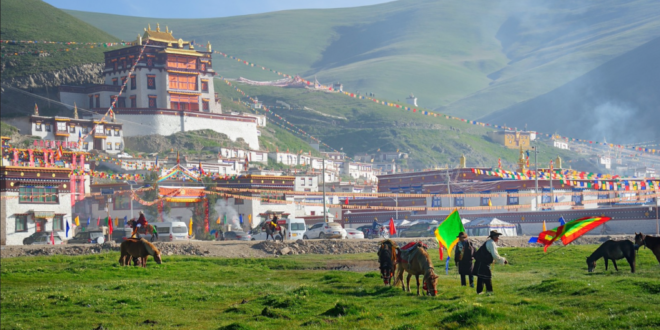
Dharamshala, 27 October 2026: As per reports from Radio Free Asia and information received, Chinese authorities may have begun, or may be in the process of carrying out, a large-scale demolition drive targeting more than 200 residential homes belonging to monks at the historic Dza Sershul Monastery (མདོ་ཁམས་རྫ་སེར་ཤུལ་དགོན་ཐེག་ཆེན་དར་རྒྱས་གླིང) in Sershul County, Karze region of Kham, eastern Tibet.
According to the information received, the demolition is believed to have commenced on either 25 or 26 October 2026, although the exact date and extent of the operation remain unverified.
Information received also indicates that Chinese authorities have been conducting public meetings in the locality while imposing restrictions on internet access and the flow of information. This has made independent verification of the scale of the demolitions and the current situation at the monastery extremely difficult.
Pattern of Demolitions and School Closures
Chinese authorities have previously carried out large-scale demolitions at prominent Tibetan Buddhist learning institutions. At Serthar Larung Gar, major demolitions began on 20 July 2016. At Yachen Gar, demolitions commenced on 8 August 2017, followed by another major demolition campaign beginning on 19 July 2019.
In recent years, the Chinese government has also reportedly forced the closure of several Tibetan-language and educational institutions, including Ragya Gangjong Sherig Norbu Lobling School in July 2024. Ragya Jigme Gyaltsen Grassland Girls’ School was reportedly closed on 27–28 August 2026, and Golog Tadrak Orphan School was reportedly forced to close on 2 September 2026.
Ragya Gangjong Sherig Norbu Lobling School and Golog Tadrak Orphan School played an important role in providing educational opportunities to Tibetan communities, particularly children from nomadic families. They offered instruction in Tibetan language and literature, traditional culture, Chinese language and vocational skills. These closures have further raised concerns about increasing restrictions on independent Tibetan-language education and the preservation of Tibetan cultural identity.
About Dza Sershul Monastery
Founded in 1760, Dza Sershul Monastery is the largest Gelug school Buddhist institution in the Dzachuka region of Sershul County, Karze, eastern Tibet. With six colleges specialising in Sutra and Tantra studies, it serves as a major centre of Buddhist learning and spirituality for surrounding nomadic communities. It is renowned for its rigorous philosophical education and authority to confer the Geshe degree, the highest academic qualification in Tibetan Buddhism. The monastery’s population was reported at around 500 in 2012, while more recent estimates place the number of monks at over 1,200.
Sometimes described as a “museum” of Tibetan Buddhism, Dza Sershul Monastery preserves valuable sacred relics and religious artefacts, including a relic attributed to Tsongkhapa, preserving sacred traditions linked to Gautama Buddha and the ancient Nalanda University in India, with a history spanning over 2,000 years. Its most prominent treasure is a 19-metre-tall, gilded copper statue of Maitreya Buddha (Jampa), the Future Buddha, reputed to be the second-largest Maitreya statue in the Tibetan regions, after the one at Tashilhunpo Monastery in Shigatse.
Beyond its religious and educational functions, the monastery operates a Tibetan medical hospital and an elderly care home serving local communities. During the 2010 Yushu earthquake, more than 900 monks reportedly participated in rescue and relief efforts, demonstrating the monastery’s wider role in humanitarian assistance and community welfare.
Earlier Incidents in Sershul
Restrictions on Monastic Education (July 2018)
In July 2018, Chinese authorities reportedly forced more than 200 novice monks under the age of 18 to leave Za Sershul Monastery and enrol in Chinese government-run schools. Authorities also ordered underage monks in the wider Dzachuka region to return to government schools. According to the Tibetan Centre for Human Rights and Democracy (TCHRD), monasteries faced pressure to comply, with possible consequences including closure of the monastery and detention of monastic leaders, staff and families. The central concern is that these measures restrict young Tibetans’ access to traditional Buddhist education and limit the transmission of religious knowledge and cultural practices between generations.
Detention of Tibetan Monks (November 2019)
Tibetan nomads had reportedly been pressured to abandon their traditional livelihoods, remove images of His Holiness the Dalai Lama, display images of Chinese leaders and publicly demonstrate loyalty to the Chinese Communist Party. Following this pressure, four monks from Dza Wonpo Ganden Shedup Monastery in Sershul distributed leaflets opposing Communist Party propaganda and calling for Tibetan independence and respect for human rights.
In November 2019, Chinese authorities reportedly detained the four monks. Two young Tibetan laymen were subsequently detained after protesting in solidarity with the monks. According to the International Campaign for Tibet (ICT), the arrests were followed by heightened security, surveillance, and compulsory political education at the monastery. This has raised concerns about religious freedom, freedom of expression and the preservation of Tibetan cultural and religious identity.
Detentions over Gold Mining (November 2025)
On 5 November 2025, residents of Kashi village in Sershul County discovered gold-mining activities at Serkhog, a traditional grazing area. Local Tibetans reportedly protested against the mining operations, and on 6 November, authorities reportedly detained around 80 Tibetans following the protests. Subsequent reports alleged that some detainees were subjected to violent interrogation and that approximately seven people remained unaccounted for at the time of reporting. A communications blackout and heightened security reportedly made independent verification difficult.
The incident has raised concerns over land rights, pastoral livelihoods, environmental protection and the treatment of Tibetan residents who opposed the mining project.
Human Rights Concerns
The reported demolition of more than 200 monks’ homes, together with the earlier incidents in Sershul, confirms the PRC government’s serious violations of religious freedom, the right to education, freedom of expression and peaceful assembly, and the right to cultural identity and its preservation of Tibetan people inside Tibet.
The forced removal of underage monks from monastic education threatens the intergenerational transmission of Tibetan Buddhist knowledge and traditions. The detention of monks and laypeople for opposing political propaganda, alongside reported surveillance and compulsory political education, restricts religious practice and dissent.
The reported detention of residents protesting gold-mining operations further establishes China’s unlawful and routine practice of arbitrary detention, denial of access to information, violation of environmental rights, and denial of the Tibetan people’s rights to traditional grazing lands and the protection of their pastoral livelihoods. It highlights the limited ability of Tibetan communities to express opposition to policies affecting their religious, cultural, social and environmental well-being.
– Report filed by the UN, EU, and the Human Rights Desk, Tibet Advocacy Section, DIIR