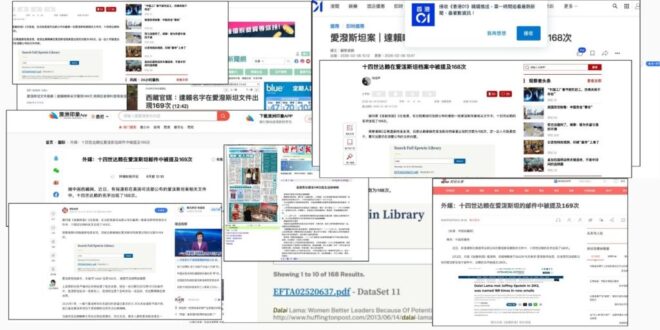
Dharamshala: State-run and affiliated media outlets in the People’s Republic of China have recently intensified their recurring smear campaigns against His Holiness the Dalai Lama following references to Him in the “Epstein Files.” These allegations, aimed at spreading misinformation and disinformation, were launched immediately after His Holiness received a Grammy Award on 1 February, seemingly to generate negative headlines and tarnish his reputation in the wake of global recognition.
The reports, widely circulated within China by parties with vested interests, continue to allege an unfounded connection between His Holiness and the “Epstein Files,” despite the official statement issued by the Office of His Holiness the Dalai Lama on 8 February. The statement unequivocally affirmed that His Holiness has never met Jeffrey Epstein, nor authorised any meeting or interaction with Him by anyone acting on His behalf.
The Central Tibetan Administration (CTA) issued a further clarification the following day, rejecting the allegations as unfounded. After carefully examining the documents released by the U.S. Department of Justice, the CTA has stated that there is no evidence of any direct participation, confirmation, or acknowledgement by His Holiness the Dalai Lama—or by any representative acting on his behalf—in relation to Jeffrey Epstein.
The CTA, led by Sikyong Penpa Tsering, on 11 February, also issued an alert over circulation of a forged document bearing the official letterhead of His Holiness the Dalai Lama, apparently intended to mislead the public.
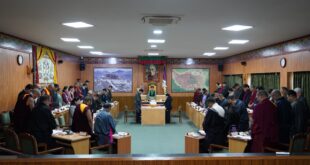
On 10 February, during the concluding ceremony of the Geneva Forum 2026, Sikyong Penpa Tsering stated in his address, “The first sources of those smear campaigns were coming from China, claiming that His Holiness had met Epstein and that the purpose of the meeting was to seek financial support.”
Sikyong further said, “Three days ago, the Office of His Holiness the Dalai Lama issued a statement clarifying that His Holiness has never met Epstein. There has been no communication whatsoever. We have also verified the facts and found that His Holiness has never met Epstein at all. This is the truth. China has been using this unfounded allegation to smear the image of His Holiness.”
Sikyong added, “We have not received any funding whatsoever from Epstein—neither His Holiness nor any of the Tibetan organisations. His Holiness lives a very simple life as a Buddhist monk.”
Notwithstanding these clarifications, several media outlets within China have continued to circulate reports that associate His Holiness’ name with the “Epstein Files.” Such reporting appears to rely on selective references and unverified claims, thereby contributing to misinformation among audiences, including Tibetans within Tibet. The continued repetition of these claims, without due acknowledgment of the official statements issued in response, raises concerns regarding journalistic standards and fairness.
Following the public release of documents related to the “Epstein Files” by the U.S. Department of Justice on 30 January, certain international media outlets referenced His Holiness’ name. Subsequently, Chinese state-affiliated media amplified these references. Among the outlets reporting on the matter were CGTN, which operates under the Publicity Department of the Chinese Communist Party, and China Tibet Online, a multilingual propaganda platform focused on Tibet-related issues. These reports were further circulated by additional national and regional platforms, which largely reiterated similar narratives, at times adding commentary critical of His Holiness. Among these were Guancha.cn, Sina Finance, qq.com, Tencent News, Chinese Press, auyx.au, Ta Kung Wen Wei, Sing Tao Headlines, Macao Daily, China News Service, Borderless Comm, HK01, Anhui News, Sohu, Orange News, Sing Tao Daily, Toutiao, NetEase, Kangba TV, and Red Culture Net.
A review of the materials published by these outlets indicates that references to the official statements issued by the Office of His Holiness the Dalai Lama and the Central Tibetan Administration were either absent or very limited.
The smear campaign has also infiltrated sections of the international media outside China in an attempt to manipulate international public opinion.
The Central Tibetan Administration reiterates its call for responsible and ethical journalism, and for reporting that reflects verified facts and official clarifications in a fair and balanced manner. The call also urged the public to exercise caution over circulation of forged letters and AI generated contents.