STATEMENT
Devastating Earthquake in Drachen County, Nagchu, Tibet
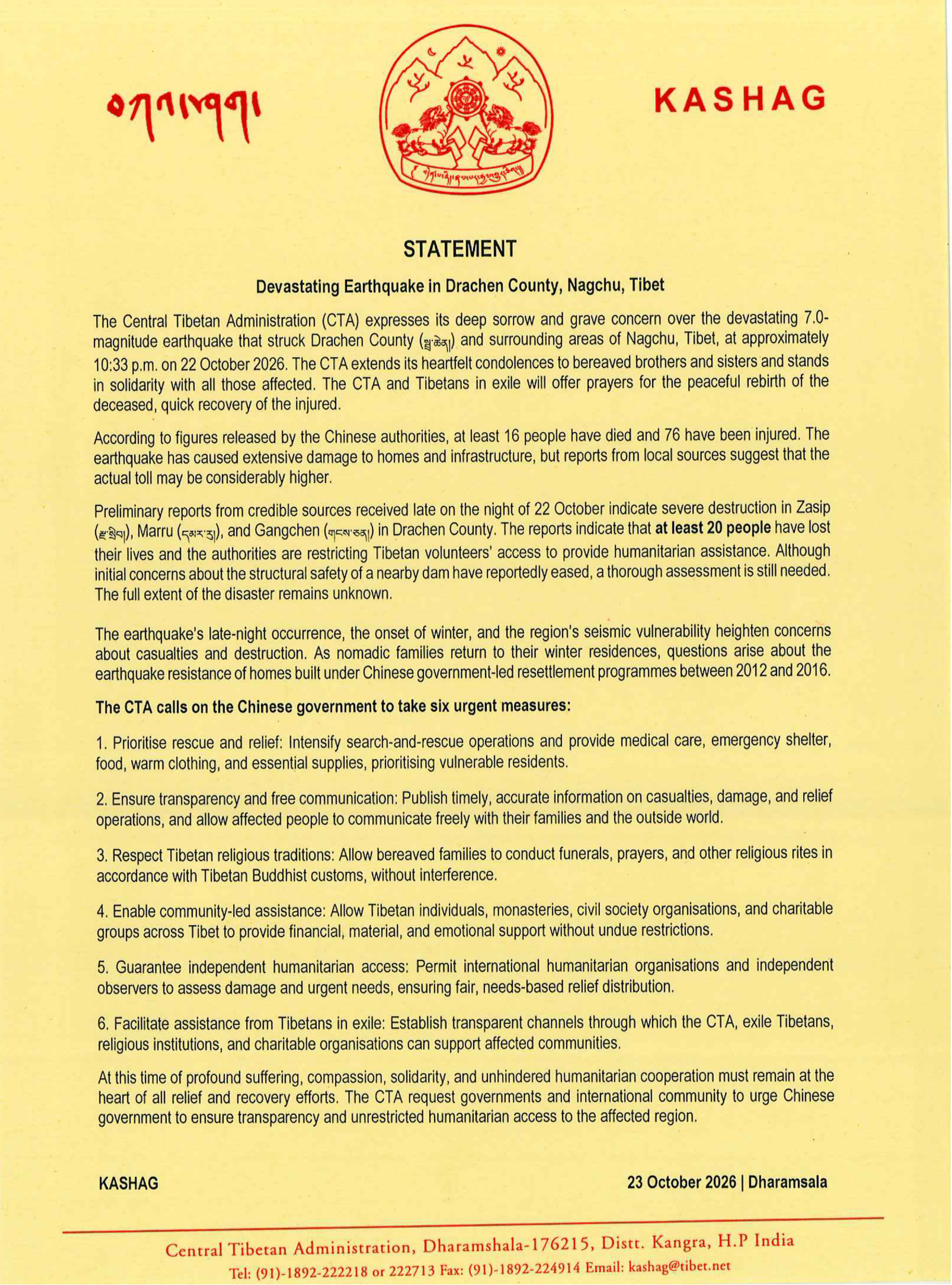
The Central Tibetan Administration (CTA) expresses its deep sorrow and grave concern over the devastating 7.0-magnitude earthquake that struck Drachen County (སྦྲ་ཆེན།) and surrounding areas of Nagchu, Tibet, at approximately 10:33 p.m. on 22 October 2026. The CTA extends its heartfelt condolences to bereaved brothers and sisters and stands in solidarity with all those affected. The CTA and Tibetans in exile will offer prayers for the peaceful rebirth of the deceased, quick recovery of the injured.
According to figures released by the Chinese authorities, at least 16 people have died and 76 have been injured. The earthquake has caused extensive damage to homes and infrastructure, but reports from local sources suggest that the actual toll may be considerably higher.
Preliminary reports from credible sources received late on the night of 22 October indicate severe destruction in Zasip (རྫ་སྲིབ།), Marru (དམར་རུ།), and Gangchen (གངས་ཅན།) in Drachen County. The reports indicate that at least 20 people have lost their lives and the authorities are restricting Tibetan volunteers’ access to provide humanitarian assistance. Although initial concerns about the structural safety of a nearby dam have reportedly eased, a thorough assessment is still needed. The full extent of the disaster remains unknown.
The earthquake’s late-night occurrence, the onset of winter, and the region’s seismic vulnerability heighten concerns about casualties and destruction. As nomadic families return to their winter residences, questions arise about the earthquake resistance of homes built under Chinese government-led resettlement programmes between 2012 and 2016.
The CTA calls on the Chinese government to take six urgent measures:
- Prioritise rescue and relief: Intensify search-and-rescue operations and provide medical care, emergency shelter, food, warm clothing, and essential supplies, prioritising vulnerable residents.
- Ensure transparency and free communication: Publish timely, accurate information on casualties, damage, and relief operations, and allow affected people to communicate freely with their families and the outside world.
- Respect Tibetan religious traditions: Allow bereaved families to conduct funerals, prayers, and other religious rites in accordance with Tibetan Buddhist customs, without interference.
- Enable community-led assistance: Allow Tibetan individuals, monasteries, civil society organisations, and charitable groups across Tibet to provide financial, material, and emotional support without undue restrictions.
- Guarantee independent humanitarian access: Permit international humanitarian organisations and independent observers to assess damage and urgent needs, ensuring fair, needs-based relief distribution.
- Facilitate assistance from Tibetans in exile: Establish transparent channels through which the CTA, exile Tibetans, religious institutions, and charitable organisations can support affected communities.
At this time of profound suffering, compassion, solidarity, and unhindered humanitarian cooperation must remain at the heart of all relief and recovery efforts. The CTA requests governments and international community to urge Chinese government to ensure transparency and unrestricted humanitarian access to the affected region.
KASHAG
23 October 2026 | Dharamsala
PRESS BRIEFING
Devastating Earthquake in Drachen County, Nagchu Region, Tibet
Department of Information and International Relations
Central Tibetan Administration
23 October 2026 | Dharamshala
-
Overview: The Kashag’s Official Response
The Kashag of the Central Tibetan Administration has expressed profound sorrow and grave concern over the devastating earthquake that struck Drachen County in the Nagchu region of Tibet at approximately 10:33 p.m. on 22 October 2026.
In its official statement issued on 23 October, the Kashag extended heartfelt condolences to the bereaved families, expressed solidarity with affected communities, and announced prayers for the peaceful rebirth of those who lost their lives and the swift recovery of the injured.
The Kashag’s statement places particular emphasis on the urgent need for humanitarian rescue and relief, transparency in reporting casualties and destruction, protection of Tibetan religious traditions, and unrestricted access for humanitarian assistance.
The CTA has also raised concerns over reports that Tibetan volunteers travelling from other parts of Tibet to assist earthquake-affected communities are being prevented from entering the disaster area.
The central message of the Kashag statement is that humanitarian considerations must take precedence over political and administrative restrictions. The Kashag has called upon governments and the international community to urge the Chinese authorities to ensure transparency and unhindered humanitarian access.
-
Earthquake Facts and Location
- Magnitude: 7.0
- Depth: 10 km
- Date: 22 October 2026
- Time: 10:33 p.m., local time in Tibet
- Epicentre: Drachen County (སྦྲ་ཆེན་རྫོང), Nagchu, Tibet, reportedly near 32.43°N, 93.82°E.
-
Reported Casualties and Damage
- Official Chinese death toll: 16
- Official Chinese injury count: 76
- Locally reported deaths: More than 20 deaths, according to information received from the affected areas late on the night of 22 October 2026.
The most severely affected locations identified in the CTA’s preliminary reports include:
- Zasip Township (རྫ་སྲིབ།): Reports of extensive destruction.
- Marru Township (དམར་རུ།): At least 10 deaths reportedly occurred in Kamlung Gal Village (སྐམ་ལུང་སྒལ།) alone.
- Gangchen Township (གངས་ཅན།): Nearly all homes in two villages have reportedly been destroyed.
There were also early concerns about the safety of a nearby dam. Although later reports suggested that the immediate danger had diminished, the CTA maintains that a thorough structural assessment remains necessary.
The full scale of casualties, damage to settlements, and infrastructure losses remains uncertain.
-
Current Humanitarian Situation in Tibet
- The situation in the affected areas remains serious, with substantial uncertainty regarding the extent of damage and the needs of survivors.
- The Kashag has identified several factors that could aggravate the disaster’s humanitarian consequences. The earthquake occurred late at night, when many residents were likely inside their homes. Winter is approaching, and nomadic families traditionally return to their winter settlements during this period.
- The immediate humanitarian priorities include search-and-rescue operations, treatment of the injured, emergency accommodation, warm clothing, food, essential supplies, and the restoration of damaged infrastructure.
- The press kit also records that Sikyong Penpa Tsering of the Central Tibetan Administration expressed profound sorrow over the loss of lives and called for transparency during the 66th founding anniversary of Tibetan Children’s Village on the morning of 23 October.
- The CTA conducted official prayer service at the Tsuglagkhang Temple on the afternoon of 23 October 2026.
-
Concerns Over Restrictions on Information
- One of the principal concerns raised by the Kashag is the availability of accurate and timely information from earthquake-affected areas.
- The Kashag has urged the Chinese authorities to publish comprehensive information about casualties, missing persons, damage, rescue operations, and the needs of affected communities.
- It has also called for affected Tibetans to be allowed to communicate freely with relatives and the outside world.
- The difference between the Chinese authorities’ official casualty figures and the higher preliminary death toll reported to the CTA underscores the importance of independent verification.
-
Reports of Restrictions on Tibetan Volunteers
- There are reports from Tibet that many initial mobilisation of Tibetan volunteers for assistance to the affected region has subsequently restricted and prohibited from travelling to the disaster area.
- The Kashag has urged the Chinese government to permit Tibetan individuals, monasteries, civil society organisations, and charitable groups to provide humanitarian assistance without undue restrictions.
-
Six Urgent Measures Demanded by the Kashag
The Kashag statement calls on the Chinese government to implement the following measures immediately:
- Prioritise rescue and relief: Intensify search-and-rescue operations and provide medical assistance, shelter, food, warm clothing, and essential supplies, particularly for vulnerable residents.
- Ensure transparency and free communication: Publish accurate information about casualties, destruction, and relief operations, and allow affected communities to communicate freely.
- Respect Tibetan religious traditions: Permit families to conduct funerals, prayers, and other religious ceremonies in accordance with Tibetan Buddhist customs.
- Enable community-led assistance: Allow Tibetan individuals, monasteries, civil society organisations, and charitable groups across Tibet to provide material, financial, and emotional support.
- Guarantee independent humanitarian access: Permit international humanitarian organisations and independent observers to assess damage and humanitarian needs and help ensure fair relief distribution.
- Facilitate assistance from Tibetans in exile: Establish transparent humanitarian channels through which the CTA, the Tibetan diaspora, religious institutions, and charitable organisations can support affected communities.
The Kashag has further appealed to governments and the international community to urge the Chinese authorities to ensure transparency and unrestricted humanitarian access.
-
Brief Background on Nagchu
- Nagchu is a vast, high-altitude region in northern Tibet, forming part of the Tibetan Plateau’s Jangthang (Changthang) grasslands. It is traditionally associated with nomadic pastoralism, particularly yak and sheep herding. The region is home to enormous presence of wildlife, vast grassland and hundreds of salt lakes.
- The region is exceptionally rich in Tibetan culture, tradition, history and nomadic way of life.
- According to the 2020 Chinese census figures cited in the CTA materials, Nagchu had approximately 504,838 residents. Drachen County is one of its administrative counties, with a population of approximately 56,200.
- The communities in the region has faced repeated forced relocation by the Chinese government to pave way for Chinese mining companies to extract rich natural resources of the region.
- The region experiences severe winters, low temperatures, and challenging transport conditions. Its high-altitude settlements and dispersed pastoral communities can present logistical difficulties during emergency response operations.
-
Previous Major Earthquakes in Tibet and Tibetan Regions
The Nagchu earthquake follows a series of destructive seismic events across Tibet.
The following selected earthquakes are drawn from Annex 3 of the CTA press kit. Magnitudes are those reported by the sources used in the annex; alternative USGS estimates are shown where supplied.
| Date | Location | Magnitude | Reported Impact |
| 25 Apr 2015 | Kyirong in Tibet, with the epicentre in Nepal | 7.8 | 27 deaths and 856 injuries reported in southern Tibet |
| 8 Aug 2017 | Namphel, Ngawa region | 7.0 | 25 deaths, 525 injuries |
| 18 Nov 2017 | Mainling, Nyingtri region | 6.9 (USGS 6.4) | More than 12,000 affected |
| 23 Jul 2020 | Nyima, Nagchu region | 6.6 (USGS 6.3) | Housing damage; no reported casualties |
| 19 Mar 2021 | Biru, Nagchu region | 6.1 | Building damage; no casualties in initial reports |
| 22 May 2021 | Matoe, Golog region | 7.4 (USGS 7.3) | More than 32,000 affected |
| 5 Sep 2022 | Luding, Kardze region | 6.8 | 93 deaths, over 400 injured |
| 7 Jan 2025 | Dingri, Shigatse region | 6.8 (USGS 7.1) | 126 deaths, 188 injuries |
| 22 Oct 2026 | Drachen, Nagchu region | 7.0 | 16 officially reported deaths, 76 injured |
These earthquakes demonstrate the region’s exposure to major seismic hazards. However, the consequences of each event depend on several factors, including earthquake depth, proximity to settlements, building resilience, and the effectiveness of emergency response.
-
Key Messages for the Media
The CTA’s position can be summarised through four central messages.
- Humanitarian concern: The Kashag stands in solidarity with the people of Nagchu and calls for urgent, comprehensive rescue and relief operations.
- Accurate information: Official casualty figures must remain subject to transparent reporting and independent verification, particularly in light of higher preliminary figures received from local sources.
- Community participation: Tibetans from across Tibet should be permitted to assist affected communities. Reports of volunteers being turned back require clarification from the relevant authorities.
- International humanitarian access: The Kashag calls for independent humanitarian assessments and appropriate channels through which international organisations and Tibetans in exile can contribute to relief and rehabilitation.
-
Concluding Briefing Message
- The devastating earthquake in Drachen County is an urgent humanitarian emergency affecting Tibetan communities in one of the world’s most important ecological zones and geographically challenging high-altitude regions, an area with a rich Tibetan culture, history, and way of life.
- While the Chinese authorities have reported 16 deaths and 76 injuries, preliminary local accounts cited by the CTA suggest a potentially higher death toll and severe destruction in several villages. The full extent of the disaster remains uncertain.
- The Kashag’s statement emphasises that the immediate priorities must be saving lives, protecting survivors, ensuring accurate information, respecting Tibetan cultural and religious practices, and enabling humanitarian assistance from within Tibet and abroad.
- The Central Tibetan Administration reiterates its readiness to assist affected communities and appeals to the Chinese government to ensure that humanitarian needs remain the foremost consideration in all rescue, relief, and rehabilitation efforts.