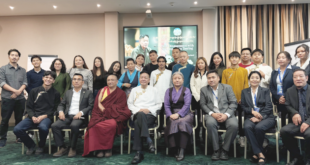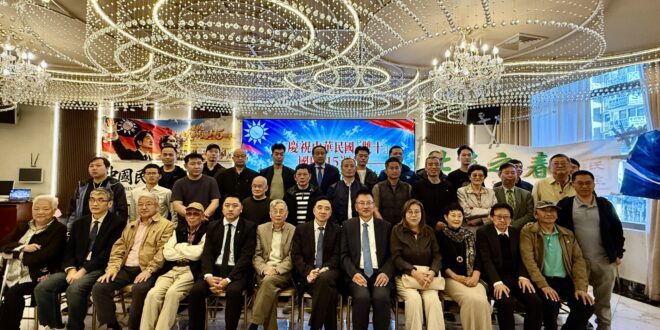
Flushing, N.Y., 6 Oct 2026: Overseas Chinese pro-democracy organisations held a forum in Flushing on Tuesday condemning Beijing’s recently implemented “Law on Promoting Ethnic Unity and Progress.” Coinciding with celebrations for the 115th anniversary of the Republic of China’s (Taiwan) “Double Ten” National Day, the event was organised by Beijing Spring magazine, the Chinese Alliance for Democracy, and the Executive Committee of the China Democracy Party. Organisers brought together overseas Chinese scholars, democracy activists, and independent journalists.
Dr. Yu Dahai, publisher of Beijing Spring, hosted and opened the conference, followed by a keynote speech from Hu Ping, the magazine’s honorary editor-in-chief. More than 20 Chinese scholars and democracy activists spoke across five panel sessions. Prominent speakers included commentator Chen Pokong, lawyer Gao Guangjun, Xue Wei (president of the Tibet-China Friendship Group), and Chen Liqun (president of the Chinese Alliance for Democracy). Tsultrim Gyatso, Chinese liaison officer at the Office of Tibet in Washington, D.C., was also an invited speaker.
In his keynote address, Hu Ping noted that while the law does not explicitly mention His Holiness the Dalai Lama or Tibetan Buddhism, its implications directly harm Tibetan identity by stripping Tibetans of core rights. He also highlighted a letter sent to Xi Jinping by a group of Chinese “princeling” leaders condemning the regime’s harsh policies toward ethnic minorities. Chen Liqun offered an apology to the communities directly affected by the law and denounced the Chinese Communist Party’s ruthless policies against Tibetans and other ethnic groups. Additional speakers argued that despite being framed as a measure to promote unity, the law instead reinforces the official narrative of mandatory “ethnic identity” and “national unification,” escalating political pressure and severely restricting the religious, cultural, and political activities of minority groups. They warned that non-Han individuals are in risk of being labeled separatists or terrorists simply for voicing grievances.
Tsultrim Gyatso argued that the law achieves the exact opposite of its stated name. Rather than fostering unity, he stated, it strips ethnic minorities of their constitutional rights and codifies a Han-centered assimilation policy around the slogan “forging a strong sense of community for the Chinese nation.” He traced the roots of assimilation in Tibet to the 1950 military invasion, noting that the “second-generation ethnic policy” advocated in the early 2000s by Chinese scholars such as Ma Rong, Hu Angang, and Hu Lianhe paved the way for this legislation, which took effect on July 1.
Tsultrim Gyatso highlighted the dire circumstances facing over one million Tibetan children currently placed in state boarding schools, many of whom are systematically losing their mother tongue. He cited the 2 July self-immolation of Lobga Rangzen outside the United Nations—following approximately 170 previous cases—as a tragic act that drew renewed global attention to the crisis. He further stated that the law violates international human rights norms, the Chinese Constitution, and the Law on Regional Ethnic Autonomy, warning that Article 63 could be weaponised against Tibetans abroad and their supporters. Finally, he noted that in response to Article 56’s mandated “ethnic unity publicity week,” the Tibetan administration declared the last week of September as “Tibetan National Identity Observance Week,” which officially launched in 23 Sept 2026.
The forum concluded with a unified condemnation of the law and an urgent call for the Chinese Communist Party to repeal it. World Journal, a major Chinese-language newspaper distributed across North America, subsequently published a report on the event.
-Report filed by Office of Tibet, Washington DC