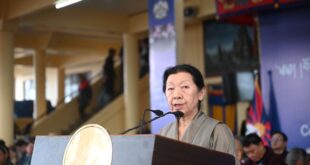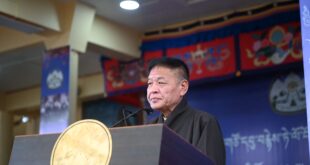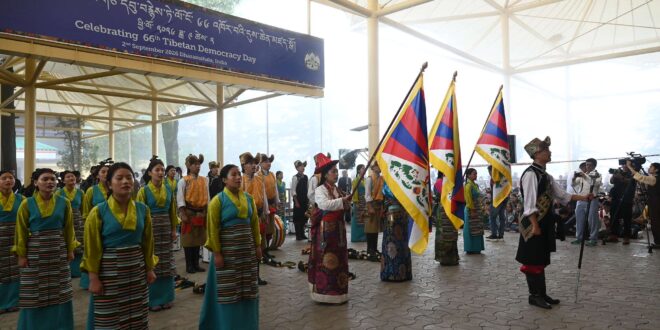
Dharamshala: Marking the 66th Tibetan Democracy Day, the leadership and staff of the Central Tibetan Administration (CTA), joined by Tibetan settlers, monastic communities, students, and representatives of Tibetan civil society from Dharamshala and surrounding areas, gathered at Thekchen Choeling Tsuglagkhang to commemorate the occasion.
The commemoration featured Tiananmen Square crackdown survivor Wang Dan as the distinguished guest of the day. Wang, who played a prominent role in organising the 1989 pro-democracy movement in China, is also the founder of Dialogue China.
The event commenced with the rendition of the Tibetan and Indian national anthems, followed by the theme song of Tibetan Democracy Day. The programme then proceeded with statements delivered on behalf of the Kashag and the Tibetan Parliament-in-Exile by Sikyong Penpa Tsering and Speaker Dolma Tsering Teykhang, respectively.
Expressing his deepest respect for His Holiness the Dalai Lama, democratic activist Wang Dan, in his remarks, recalled the recent self-immolation of the Tibetan patriot Lobga Rangzen, which once again drew global attention to what happened on the Tibetan Plateau more than six decades ago. He spoke about the subsequent aftermath, which led Tibetans to establish a democratic polity in exile in their continuing struggle for justice and freedom.
He also highlighted the eventual devolution of political responsibility by His Holiness the Dalai Lama through a gradual transition and a series of thoughtful steps. This process ultimately led to the Tibetan exile community’s direct election of the Sikyong and members of the Tibetan Parliament in Exile.
Contrasting this Tibetan democratic experience with the political system in China, Wang said, “The Chinese Communist Party relies on violence, lies, and control. The Tibetan community in exile, in contrast, relies on the recognition of its people, democratic legitimacy, and a coalition of its institutions. It is obvious that this democratic system has brought together the Tibetan people across the world,” thereby ensuring that the Tibetan voice will never be silenced by the Chinese government.

Notably, Wang said that Chinese pro-democracy activists in exile are also preparing to establish the China Congress, with more than a thousand founding electors having already participated in the process.
“We hope to bring democratic practices belonging to the Chinese people, accumulate experience for China’s future democratic transition, and contribute to constitutional development,” he said. He added that the Tibetan Parliament in Exile could serve as a valuable model for this endeavour.
Addressing the lack of democratic institutional representation within the Chinese democratic movement, Wang said the China Congress could learn much from the Tibetan democratic experience. He emphasised that a future democratic China should never repeat the repressive and assimilative policies of the Chinese Communist government. Instead, it should respect Tibetan religion, culture, language, and national identity, creating the conditions for respectful dialogue on an equal footing.
He further went on to commend the Central Tibetan Administration’s Middle Way Policy.
During the commemoration, two CTA staff members who have completed 25 years of service with the Central Tibetan Administration were presented with recognition certificates in appreciation of their dedicated service.
Seven PhD candidates were awarded ₹20,000 each in recognition of their academic milestone. Ten Class XII graduates who topped their respective streams—Science, Commerce, and Arts—among Tibetan students across India in their board examinations were accorded the Gaden Phodrang award. Of these, four students who secured 95 percent or above were additionally presented with Excellence Awards.
The event also witnessed the launch of several publications. These included a compilation of articles addressing the People’s Republic of China’s lack of rights to intervene in the matter of His Holiness the Dalai Lama’s reincarnation; a compilation of His Holiness’s speeches delivered to the Tibetan Parliament-in-Exile; the third volume of The Evolution of Tibetan Democracy in Exile; a translated work by former Tibetan Parliamentarian and Representative Lobsang Shastri, titled The Chronicle of Tibet’s Foreign Relations and Policy (7th–21st Century); and a publication by the Tibet Policy Institute documenting the history of relations between Tibet and its neighbouring nations.
As part of the commemoration, and in an effort to promote the preservation and continued practice of Tibetan culture amid growing challenges, students from Upper Tibetan Children’s Village School, TCV Day School McLeod Ganj, Gangkyi Petoen School, Yongling Crèche and Kindergarten, and the Tibetan Institute of Performing Arts presented a cultural programme.