A Rimé Vision for Our Times
I was with him then—decades ago—on a journey that was far more than a quiet interlude. It was a pilgrimage across the fault lines of history, where ancient faiths had collided, both in beauty and bloodshed. He moved gently between traditions that had so often been at war—between mosque and synagogue, church and shrine—each one a vessel of deep devotion and accumulated sorrow.
He honoured the Jewish Sabbath with quiet care, attended a Christian service with reverence, removed his shoes to enter the Al Aqsa Mosque, and stood in stillness before the Western Wall. In Haifa, he wandered through the serene terraces of the Baháʼí, recognising in their graceful exile a reflection of Tibet’s own dispossession. At Yad Vashem, the Holocaust memorial, he bowed his head for a long, unhurried silence. It was not mere remembrance—it was communion with a people marked by the trauma of annihilation.
He was welcomed by all—rabbis, imams, priests, and ordinary believers. But this was not mere hospitality. It was recognition. He came without dogma, carrying only a presence shaped by exile and the slow patience of suffering. In the displacement of Jews and Palestinians alike, he saw echoes of Tibet’s own broken story. Yet he never claimed equivalence—only kinship. He honoured each grief as distinct, each tradition as whole.
There were no grand declarations, no slogans or performances. What he offered was more elemental: a bowed head, a silent prayer, a listening heart. In a land where memory itself is contested, he moved as one with no territory to defend—only a humanity to uphold. And now, when rage once again overwhelms reason, and the sacred is too often used to justify the unspeakable, that moment feels even more urgent. He did not come to convert, to condemn, or to compare. He came to bear witness. And in doing so, he became a bridge—quiet, human, enduring.
What does it mean, then, when this same Buddhist monk says, “Compassion is my religion”? In that moment, it became clear: these are not words of spiritual convenience. They are a declaration of intent—a commitment to walk the talk in the most divided, vulnerable spaces of our world.
This is no abstract theology. It emerges from Rimé—literally “without bias”—a Tibetan Buddhist movement that honours difference without demanding sameness. Rooted in lived experience, Rimé does not seek to collapse traditions into a vague unity. It encourages a deeper discipline: to enter other worlds with humility, to listen without comparison, to learn from within. Where fundamentalism insists on loyalty and secularism shrugs at meaning, Rimé proposes something far more radical—genuine reverence for other paths, cultivated through encounter.
Its relevance today is not limited to monasteries, academic conferences, or interfaith committees. It speaks urgently to all of us—because we are drowning. Not metaphorically, but visibly. As sectarian rage, cultural entitlement, and ideological absolutism spread like wildfire, we are still arguing about who threw the first match. What His Holiness models is not neutrality—it is moral courage anchored in humility. He reminds us that to cross a threshold in silence, to bow before another’s grief, may be the most powerful form of solidarity there is.
The Silence That Changed Everything
To understand the Dalai Lama’s revolutionary practice, we must begin where it all started: with silence. When the Buddha attained enlightenment and arose from the direct experience of reality as it truly is, what followed was not celebration, but stillness. A profound, interior quietude. He found himself unable to speak—not out of reticence, but because what he had seen was beyond language. It was non-conceptual, not subject to the mechanics of thought or the scaffolding of speech. No words could encompass it. He had left behind his companions and followers. Now awakened, he wondered how they fared, and whether what he had come to know could ever be conveyed.
This moment is of immense significance. For unlike many traditions—without diminishing any—the Buddha’s insight was not formulated through revelation, doctrine, or commandment. It was not mediated by the word. Indeed, the very act of putting it into words would have reduced its truth. Vocabulary, after all, is limited. The nature of reality, as the Buddha experienced it, was not.
Yet from this silence emerged a teaching. He began with what could be shared: a method, and a wisdom. Method, as practice. Wisdom, as insight shaped by words—however imperfect those words might be. That is why the first discourse, the first turning of the Wheel of Dharma, was modest in form but immense in implication. Just four truths: that suffering exists; that it has causes; that there is liberation from suffering; and that there is a path to that liberation. These were not abstractions. They were direct, digestible, deeply rooted in the experience of every human being. And they became the axial truths on which all Buddhist thought and practice would grow.
Over centuries, those early teachings would unfold into vast systems of thought and contemplative practice. But even as the Dharma deepened in complexity, the Buddha consistently urged his followers: do not accept my words on authority alone. Test them. Live them. Let reason, logic, and your own experience be the final authority. The Dharma was not frozen in its original utterance. It was evolutionary by nature. As new teachers emerged across cultures and centuries, they refined methods suited to the temperaments and conditions of their time. What they transmitted was not mere belief, but reflections—shimmering, imperfect, provisional—of the original experience of enlightenment.
This capacity for renewal gave rise to Buddhism’s many schools and lineages. Unlike Hinduism, which often absorbed other traditions into its fold, Buddhism was itself absorbed—transplanted from India to Tibet, China, Southeast Asia. In each place, it encountered indigenous traditions, and instead of resisting them, it listened. It adapted. In Tibet, it met the shamanic Bön tradition and evolved into something entirely new—yet unmistakably Buddhist. The essence remained, even as the forms transformed. Each culture received not a foreign dogma, but a mirror held up to its own aspirations.
The silence that followed the Buddha’s awakening did not mark an end. It was the beginning of a conversation that continues, still, in many voices—but always rooted in the same stillness. This is the ground on which the Dalai Lama stands. His ease with other faiths does not come from diplomacy alone. It comes from a tradition that has never claimed to have the final word.
Different Medicines for Different Ailments
His most revolutionary insight: the concept of “mental diets.” Just as our bodies require different nutrition, our minds thrive on different spiritual approaches. This understanding, influenced by Swami Vivekananda’s teaching on multiple yogic paths, acknowledges fundamentally different human temperaments in ways that most religious leaders have found threatening.
Vivekananda’s four archetypes—Karma Yoga, Raja Yoga, Bhakti Yoga, Jnana Yoga—recognised that each individual has a different mental disposition. These are not linear, isolated, packaged systems but overlapping approaches that serve different needs. From this springboard, His Holiness developed his understanding that each of us requires a different mental diet, just as we need different physical diets.
For one person, Islam’s emphasis on surrender and community responsibility provides perfect nourishment. For another, Christianity’s focus on love and service resonates most deeply. Others find sustenance in Buddhism’s mindfulness traditions or Hinduism’s philosophical sophistication. Some thrive on the rigorous intellectual inquiry of Jewish scholarship, whilst others are drawn to the ecstatic devotion of Sufi practice.
“If you’re a Christian, be a good Christian,” he says repeatedly. “If you’re a Muslim, be a good Muslim.” This is not tolerance—that patronising endurance of difference. This is recognition of diversity as essential to human flourishing, as necessary as biodiversity is to planetary health.
I remember moderating a dialogue between Archbishop Rowan Williams and His Holiness in London. Williams thanked him for “creating the precedent for engagement with science” when many religious leaders saw scientific discovery as threat. The Dalai Lama’s response was characteristically direct: “We must embrace all knowledge, particularly contemporary knowledge. Truth cannot contradict truth.”
This openness emerges from Buddhism’s central insight: if ultimate reality transcends conceptual understanding, no tradition can claim exclusive access through doctrine alone. Each tradition offers different methods for approaching the ineffable, serving different temperaments and cultural contexts. The criterion becomes practical rather than theological: do particular beliefs and practices increase compassion, wisdom, and wellbeing, or do they generate attachment, hostility, and suffering?
Two Teachers, One Path: A Personal Testimony
Among the most enduring influences on His Holiness the Dalai Lama’s interfaith vision is a figure he often invokes with quiet reverence: Sri Ramakrishna Paramahamsa. This nineteenth-century mystic did not merely speak of tolerance—he lived its truth with a radicalness that still unsettles conventional religious minds.
Ramakrishna stepped beyond the precincts of his temple and immersed himself in the disciplines of other faiths. Under the guidance of a Sufi master, he lived as a Muslim. He practised Christianity, Sikhism, Tantra under a woman teacher named Bhairavi Brahmani, and Advaita Vedānta under the austere Tothapuri. These were not symbolic gestures or academic exercises. They were acts of spiritual courage—immersive explorations undertaken with the sincerity of a seeker, not the superiority of a teacher already convinced of his own path’s supremacy.
What emerged from this extraordinary journey was a luminous conclusion that would echo across centuries: “God is one, but these are all different experiences and manifestations of the Divine. And so, we honour them all.” That spirit of honour—not mere tolerance—would come to form the architecture of my own inner life, though I had no way of knowing it at the time.
My first diksha, while still in my teens, was from Swami Ranganathananda of the Ramakrishna Mission, who would later become its revered president. He recognised in me—long before I did—a natural gravitation toward the Buddha’s teachings. With gentle persistence, he nudged me deeper into that exploration until, eventually, I encountered His Holiness the Dalai Lama. The threads had begun to weave themselves into a pattern I’m still learning to read.
His Holiness has been, and remains, my root teacher in a relationship of samaya—sacred commitment. I remain a testament to his extraordinary patience, for he has continued to work with me despite the countless straws that inhabit my brain and the frequent confusion that clouds my understanding.
There is something quietly revelatory in knowing that when Sri Ramakrishna passed, Swami Vivekananda kept a dedicated room in his Calcutta home where he would meditate upon the Buddha. The Ramakrishna Mission itself quietly models the Buddhist Sangha—inclusive, decentralised, egalitarian in spirit, and remarkably free of scandal over 150 years. It celebrates difference without threat, and upholds unity without demanding uniformity. Vivekananda once said, “The Buddha is my Ishta. Sri Ramakrishna is my master,” reconciling the rigour of philosophical inquiry with the devotion of a bhakta.
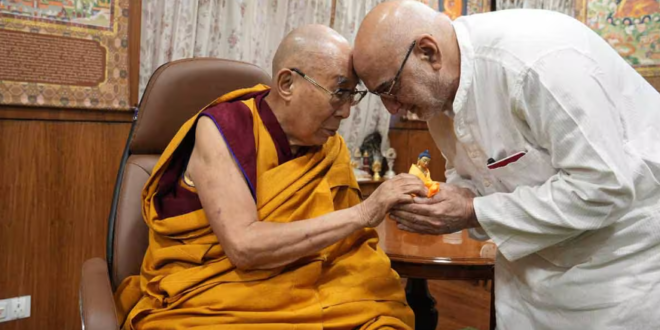
By grace or good fortune, I was later blessed to introduce Swamiji and the Dalai Lama to one another—not merely as leaders of their respective traditions, but as fellow travellers on paths that had never really been separate. I moderated a historic conversation between them that His Holiness later wrote about in The Kinship of Faiths, a rare and deeply moving book that captures moments when great rivers meet—each distinct in source and flavour, yet flowing toward the same ocean of understanding.
The two of them—one Hindu, the other Buddhist—did not simply affirm the legitimacy of multiple paths in abstract terms. They embodied that truth in their very presence. Their lives bore witness to the fact that the spiritual quest, while diverse in form, is united in its essence. And because of them, this approach to living diversity—of reverence across difference—is not merely an idea I have studied. It is a path I have been privileged to walk, and at times, to serve.
When Understanding Becomes Participation
The Dalai Lama’s celebration of diversity emerges not from scholarly study but from immersive engagement. This is a man who doesn’t merely discuss religious diversity—he inhabits it.
In Vrindavan, I watched him participate directly in Hindu rituals, performing abhishek of the Shiva Lingam and joining homa ceremonies. These were not diplomatic courtesies but genuine spiritual exploration, approaching each practice with the same focused attention he brings to Buddhist meditation. I saw him close his eyes during the fire rituals, not as an observer making mental notes, but as a practitioner allowing the ancient rhythms to work on his consciousness.
His encounters with Sikhism reveal profound respect for seva—selfless service—and radical equality. I’ve seen his eyes light up discussing the langar tradition, those community kitchens where anyone, regardless of background, is fed with dignity. “This is compassion in action,” he says, recognising in Sikh practice a living embodiment of the interdependence he teaches philosophically. When he speaks of the Golden Temple, it’s with the appreciation of someone who understands that the Guru Granth Sahib contains not just Sikh wisdom, but verses from Hindu and Muslim saints as well—a scripture that itself celebrates diversity.
Perhaps nowhere was his experiential approach more moving than during our journey to Jerusalem’s holy sites. At the Western Wall, he stood in respectful silence, understanding through presence the depth of Jewish longing and devotion accumulated across millennia of persecution and hope. But his visit to Al Aqsa Mosque revealed the true nature of his engagement.
I accompanied him that day, watching as he removed his shoes and entered with the reverence of a genuine pilgrim. In the mosque’s serene courtyard, surrounded by centuries of Islamic prayer, he didn’t simply observe—he absorbed. He asked detailed questions about prayer practices, architectural symbolism, the rhythm of worship that structures Muslim life. When the call to prayer echoed across Jerusalem’s ancient stones, he listened not as an outsider making anthropological observations, but as someone genuinely seeking to understand how this particular form of surrender shapes human consciousness.
His book The Good Heart exemplifies this experiential approach. Rather than offering abstract commentary on Christianity, he provides Buddhist perspectives on specific Gospel passages, finding resonances that illuminate both traditions without collapsing their differences. In one remarkable moment, he suggested Jesus “may have reached a high state, either as a Bodhisattva, or an enlightened person, through Buddhist practice.” This wasn’t theological conquest but genuine attempt to find common ground through shared understanding of spiritual development.
After September 11th, when anti-Muslim sentiment peaked and interfaith dialogue became a political necessity rather than spiritual calling, he gathered with American Muslims and Buddhists not for more talking but for shared practice—demonstrating that understanding emerges from praying together, not merely from discussing prayer.
This approach reflects his deep appreciation for Ramakrishna’s model: don’t simply study other traditions—live them sufficiently to understand how they work on human consciousness. Through such engagement, he has discovered that different methodologies serve the vast spectrum of human temperaments and spiritual needs in ways that purely intellectual comparison never could.
The Alchemy of Mind Training
Central to his vision is something rarely discussed in interfaith contexts: mind training. The deliberate cultivation of mental qualities that serve both individual wellbeing and social harmony. Where most people invest enormous energy in physical fitness and professional development, few dedicate equivalent attention to training their minds—despite the fact that the mind processes all experience and its qualities determine how we interpret everything.
Buddhist tradition offers sophisticated techniques, tested across centuries of contemplative experiment. Meditation on interdependence reveals how deeply we depend on countless others—from farmers growing our food to engineers designing our infrastructure, from teachers who shaped our thinking to artists who enlarged our imagination. This recognition naturally generates connection and responsibility rather than the isolation that comes from imagining we’re self-made.
More challenging practices include “exchanging oneself with others”—visualising taking in others’ suffering as black smoke whilst sending out healing as golden light. Through repetition, such practices gradually reshape the mind’s habitual patterns, moving responses beyond intellectual understanding to embodied compassion. These aren’t sentimental exercises but rigorous mental training, as demanding as athletic preparation and far more consequential.
This experiential understanding shapes his teaching about different spiritual approaches. He doesn’t theorise about mental diets—he has witnessed their effects firsthand. Watching Islamic devotees in prayer, he observes how the rhythm of submission cultivates specific mental qualities of surrender and community consciousness. Participating in Christian contemplative practices, he recognises how love-centred meditation generates its own transformation of the heart. These aren’t abstract comparisons but lived observations of how different methodologies work on human consciousness.
The Dalai Lama often says that the real goal of all religions is the cultivation of a good heart: love, compassion, forgiveness, and inner peace. These qualities are not doctrinal additions but foundational necessities. Every human dilemma, whether personal or planetary, ultimately turns on the quality of heart and mind with which we meet it. His Holiness insists that if religion does not reduce suffering and enlarge compassion, it fails its own reason for being.
Wealth, power, even knowledge can be turned to harm if they are not governed by kindness. Conversely, a caring motivation can redeem limited resources and imperfect understanding. A good heart, then, is not sentimental decoration. It is the necessary compass that gives direction to all other human capacities—the inner resource that determines whether our skills serve wisdom or folly.
Where Science Meets the Sacred
No aspect of his approach has proven more revolutionary than his engagement with modern science—a dialogue that many religious leaders still view with suspicion. Through initiatives like the Mind and Life Institute, he has fostered groundbreaking research into consciousness, neuroplasticity, and the measurable effects of contemplative practice on brain structure and function.
Neuroscience now confirms what contemplatives have long claimed: sustained meditation literally reshapes the brain, strengthening areas associated with attention, emotional regulation, and compassion whilst reducing activity in regions linked to anxiety and self-centred rumination. These aren’t beliefs requiring faith but empirical discoveries that can be measured, replicated, and studied regardless of one’s religious affiliation.
Quantum physics demonstrates that reality depends fundamentally on the observer—a scientific insight that resonates powerfully with Buddhist teachings on emptiness, the recognition that phenomena exist only in dependence upon causes, conditions, and perspectives. If the fundamental nature of reality is observer-dependent, then no tradition can claim exclusive access to absolute truth. Different approaches—scientific, religious, cultural—represent different ways of participating in reality’s creation.
This convergence has generated practical applications that benefit people regardless of their spiritual commitments. Mindfulness-Based Stress Reduction brings meditation into medical settings without requiring belief in rebirth or karma. Delhi’s “happiness curriculum” introduces contemplative practices into schools based purely on wellbeing research, not religious doctrine. Secular meditation programmes in prisons, hospitals, and corporate settings demonstrate that inner development serves human flourishing quite apart from theological frameworks.
What emerges is not the reduction of spirituality to neuroscience, but recognition that the transformation religious traditions have always sought can now be understood, measured, and refined through scientific method. This doesn’t diminish the sacred—it validates the practical wisdom that contemplatives have been developing for millennia.
Learning from Nalanda: The Art of Constructive Disagreement
The Dalai Lama frequently references Nalanda University as a model for how different traditions can engage constructively without compromising their authentic commitments. This ancient Indian institution welcomed scholars from Buddhist, Hindu, and Jain traditions, fostering intellectual dialogue that strengthened rather than threatened distinctive understandings.
Debates at Nalanda were designed not to establish superiority but to illuminate diverse perspectives through rigorous examination. When Buddhist philosophers developed new ideas, they presented them to audiences that extended far beyond Buddhist assumptions. This demanding environment ensured that teachings could withstand scrutiny from multiple viewpoints—a quality control mechanism that generated synthesis without forcing superficial agreement.
The result was intellectual humility combined with authentic commitment—recognition that engaging other traditions could strengthen rather than weaken one’s own understanding. Nalanda demonstrated that diversity of approach serves the pursuit of truth better than enforced uniformity, and that genuine confidence in one’s path enables rather than restricts appreciation of other journeys.
This model suggests practical approaches for contemporary challenges. Rather than seeking theological agreement, communities might focus on shared humanitarian concerns: climate change, poverty, social justice. These crises require responses that draw from multiple traditions’ wisdom whilst respecting their distinctive contributions. Environmental destruction, for instance, needs responses that integrate indigenous wisdom about living harmoniously with nature, Buddhist understanding of interdependence, Christian teachings on stewardship, Islamic principles of balance, and scientific knowledge about ecological systems. No single perspective suffices.
No Single Reality, But Truth That Transcends Doctrine
Perhaps the most challenging aspect of his vision involves accepting that no single, absolute reality exists that all traditions must acknowledge in identical terms. This doesn’t lead to relativism—the claim that all perspectives are equally valid—but recognises that different approaches serve different purposes and populations.
Buddhist teachings on emptiness suggest that phenomena, including religious traditions, exist only in dependence upon specific causes and conditions. Each tradition arose in response to particular circumstances and continues serving specific human needs that vary across cultures, temperaments, and historical moments.
This understanding creates space for multiple valid approaches to spiritual development without requiring them to be identical in content or method. Rather than seeing different religions as competing descriptions of reality, one can appreciate them as different ways of engaging reality that produce different results for different people.
The criterion for evaluation becomes practical rather than theoretical: do particular beliefs and practices increase compassion, wisdom, and wellbeing, or do they generate attachment, hostility, and suffering? This standard can be applied by people of any tradition whilst maintaining their distinctive commitments. A good Christian becomes more Christ-like through deepening practice, not by becoming a Buddhist. A sincere Muslim grows in surrender to Allah, not by adopting Hindu concepts. Yet both may learn from contemplative techniques developed in other traditions without compromising their fundamental allegiances.
The World Is Drowning: Why This Matters Now
But why does this approach to religious diversity matter now, more urgently than ever? Because look around. Gaza bleeds whilst the world argues about who started what. Ukraine buries its children whilst diplomats debate territories. Myanmar’s Rohingya flee whilst we count refugees like statistics. Kashmir’s students become casualties whilst politicians declare zero tolerance for dialogue.
In each crisis, the pattern repeats: brute power strikes, people suffer, and we respond with more of the same—airstrikes, sanctions, walls that keep growing higher. Meanwhile, we spend over $2.4 trillion annually on weapons whilst a fraction of that could educate every child and bring clean water to every village. As the Dalai Lama observes with characteristic precision, “We are over-armed and under-educated.”
This is precisely why his vision of religious diversity matters—not as academic exercise but as practical necessity for species survival. The challenges we face—climate catastrophe, global inequality, technological disruption that outpaces human wisdom—require cooperation that transcends traditional boundaries. No single tradition, nation, or ideology possesses sufficient understanding to address what threatens us all.
His model offers something desperately needed: a way to maintain authentic commitment whilst engaging genuine difference constructively. In my forty years observing him, I’ve witnessed how this works in practice. When religious leaders from different traditions gather in his presence, something shifts in the room’s atmosphere. The defensiveness drops. The compulsive need to prove superiority evaporates. Space opens for actual learning rather than mutual suspicion.
I remember a particularly tense interfaith gathering where tensions between religious communities mirrored broader geopolitical conflicts. His Holiness listened to heated exchanges about theological differences, historical grievances, contemporary injustices. Then he spoke quietly: “When a child is drowning, do we ask their religion before helping?” The room fell silent. “Our world is drowning. Perhaps we might help first, argue later.”
This isn’t naive idealism but practical wisdom born from direct experience of what actually transforms human behaviour. He has seen how participation in other traditions’ practices naturally generates respect rather than competition. When Christians meditate on interdependence, they discover connections to Buddhist insight without abandoning Christ. When Muslims engage loving-kindness practice, they recognise resonances with Islamic teachings on compassion without compromising their submission to Allah.
The genius of his approach lies in recognising that depth within one tradition enables rather than restricts appreciation of others. Only when we’re securely rooted can we engage difference without defensiveness. Only when we’re confident in our own path can we learn from other journeys without losing our way.
Compassion as Universal Currency
“Let the pain you see make you more human,” he teaches. In our interconnected age, this wisdom becomes survival strategy. The suffering in Gaza touches hearts in Delhi. Ukraine’s anguish reverberates in Jakarta. Myanmar’s tragedy echoes in São Paulo. We are witnessing humanity’s pain in real time, across every screen, through every feed.
The question becomes: will this shared witnessing of suffering harden our hearts or expand them? Will it drive us deeper into tribal loyalties or awaken us to our fundamental interconnection? The Dalai Lama’s life demonstrates that the choice is ours, and that the consequences extend far beyond personal spiritual development.
His approach to religious diversity offers a template for everything else: how to engage political differences without demonising opponents, how to address economic inequality without ignoring legitimate concerns, how to tackle environmental challenges without dismissing valid fears about change. The same inner resources that enable appreciation of religious diversity—patience, curiosity, intellectual humility, compassion—serve constructive engagement across every form of difference that divides us.
Social justice movements might draw from Christianity’s prophetic tradition, Islam’s emphasis on economic equity, Buddhism’s analysis of systemic suffering, Hinduism’s recognition of divine presence in all beings, and secular insights into institutional change. The most effective responses emerge from multiple wisdom traditions working together whilst maintaining their distinctive contributions.
Educational systems preparing young people for an interconnected world might teach not just about different religions but how to learn from them—developing the inner resources necessary for constructive engagement across difference. This means cultivating not just intellectual knowledge but the emotional intelligence and spiritual maturity that enable appreciation rather than appropriation.
Political leaders might learn from his example how authentic dialogue across ideological differences becomes possible when participants focus on shared concerns rather than theoretical disagreements. Climate action, poverty reduction, conflict prevention—these challenges transcend partisan politics and require collaboration across traditional boundaries.
The Gift to Our Fractured Age
At ninety, his voice grows frail but his message intensifies. Tibet may not be free, but its moral vision has never been more relevant. In a world fragmenting along religious, cultural, and ideological lines, he embodies the possibility of unity through diversity rather than despite it.
“Compassion is my religion”—this declaration points toward humanity’s next evolutionary step. Not the abandonment of particular traditions but their maturation into vehicles for universal care. Not the erasure of differences but their transformation into resources for addressing shared challenges.
The capacity for adaptive authenticity reached an extraordinary milestone recently when the Asian Buddhist Conference—drawing together the full spectrum from Theravāda to Mahāyāna—unanimously affirmed His Holiness as the most respected Buddhist monk of our time. Not because he claimed greater enlightenment or sought such honour, but because he speaks for the whole tradition with rare moral clarity, uniting its multiplicity without flattening its richness. Here was Buddhist consensus not built on coercion or hierarchy, but on recognition—the kind that arises when wisdom meets humility, and ancient tradition engages contemporary necessity.
The path forward requires individuals willing to do the inner work that enables outer engagement—developing the mental training that moves responses beyond reactivity to genuine wisdom. It requires communities that create space for diverse approaches to flourish whilst collaborating on common concerns. It requires leaders who embody the possibility of authentic commitment combined with generous engagement.
Most importantly, it requires recognising that the choice between preserving our traditions and engaging others constructively is false. The deepest practice of any tradition naturally generates the qualities that enable appreciation of all traditions. The most authentic commitment to one’s own path creates the security necessary for learning from other journeys.
This is the Dalai Lama’s gift to our fractured age: demonstrating that celebrating religious diversity is not about weakening our convictions, but rather about strengthening our humanity. In a world desperate for both wisdom and cooperation, this may represent our most promising foundation for whatever future we can still create.
The silence that followed the Buddha’s awakening two and a half millennia ago continues to speak. In the Dalai Lama’s patient engagement with every tradition he encounters, in his willingness to learn rather than lecture, and in his embodiment of diversity as a strength rather than a threat—we hear echoes of that original stillness from which all genuine teaching emerges.
Compassion is indeed his religion. The question for our times: will we allow it to become ours as well?
………………………………………………………………………………………………………………………………………………………………………………………………………………………………
Note: Rajiv Mehrotra is the Managing Trustee of The Foundation for Universal Responsibility of HH The Dalai Lama. The views expressed in this article belong solely to the author and do not necessarily reflect the official stance or policy of the Central Tibetan Administration.